



On a recent trip to Greece and Turkey, I enjoyed visiting the amazing ancient ruins, including the Acropolis, Philippi, Meteora, and Ephesus. I loved the design language, the way the cities were laid out, and the incredible artistry. I marveled at how they accomplished all of this with ancient tools and no electricity.
I was also amazed by the ancient marble steps, which were incredibly slippery in the rain and sometimes even when dry. With the endless towers of marble steps, I would have been a busy, busy therapist back then with all of the slips, trips, and falls they probably experienced.
In every evaluation we perform on new patients, the patient’s ability to manage steps is taken into consideration. Being able to stand up from sitting and move well on flat surfaces is certainly important, but many homes have stairs, and patients who will eventually return to those homes need to be able to safely navigate them to be as independent as possible. That’s just how common—and important—steps are in modern-day society.
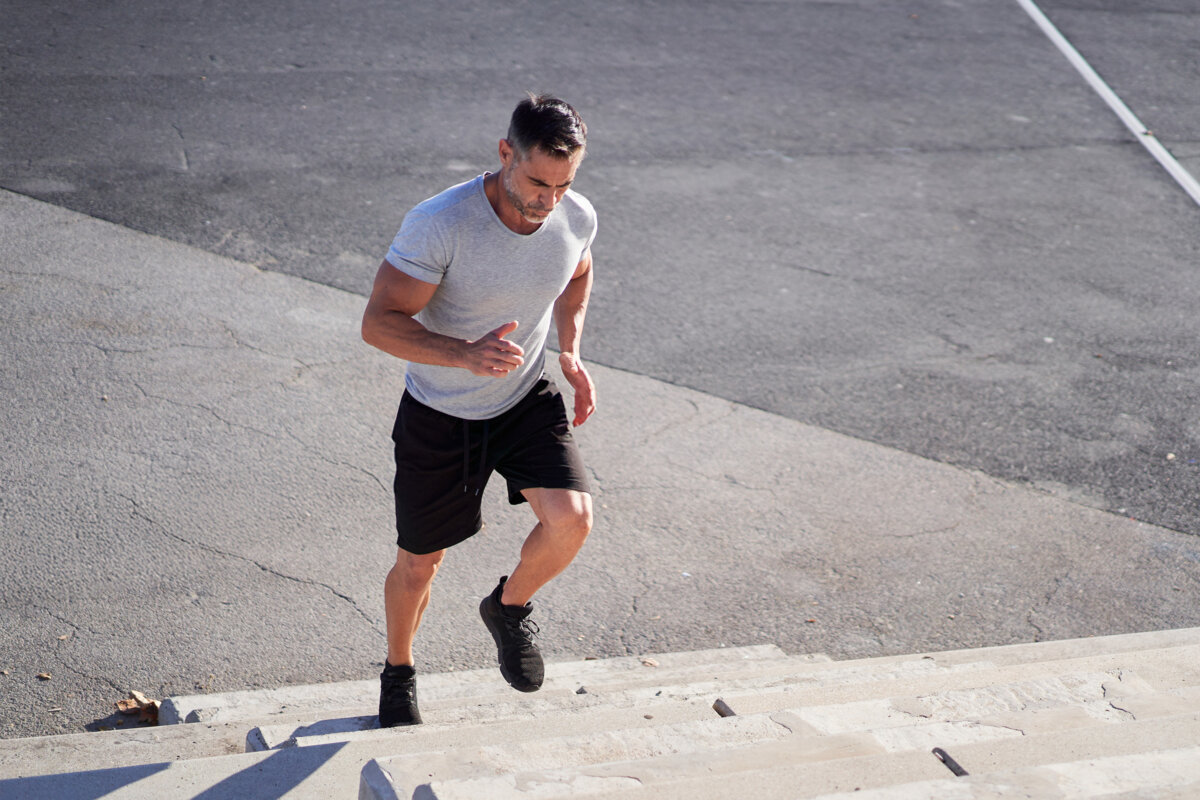
Stairs are great for navigating changes in elevation, but they are also great for something else: exercise. Because stairs encourage natural biomechanics, they are excellent for strengthening the lower body and cardiovascular health.
5 Stair Exercises for Strength and Cardio Health
The following exercises are great for both strengthening muscles and tuning up your cardiovascular fitness. They are generally easy to perform and easy on your body, and my patients tolerate them well. However, I do suggest that you consult with your medical provider to ensure that they are right for you.
1. Up-Up-Down-Down
This basic stepping movement makes the most of a simple exercise, using nothing more than the first step of your staircase.
Step 1: Stand facing your staircase. Step up onto the first step with your right foot. Next, immediately and smoothly bring your left foot up onto the step.
Step 2: Step back down with your right foot, followed by your left foot.
Step 3: Stepping up and then back down counts as one repetition. Try to perform three sets of 20 repetitions per side. You can complete all exercises with your right foot first, then your left, or alternate between stepping up with your right and left feet.
Modifications: Rushing can make this activity less effective and decrease safety; therefore, keep your pace slow and steady to maintain control.
Why I Like Them: Stepping up and down is quick, easy, highly effective, and has a rhythm to it that is easy to learn. It’s an excellent cardiovascular exercise.
2. Lateral Step-Ups
Lateral step-ups turn the standard up-and-down step 90 degrees to the side, changing the biomechanics needed to perform it.
Step 1: Stand sideways to the staircase, with your hands by your side. Be sure to have your right side facing the step.
Step 2: Step sideways onto the step with your right foot, bringing your left foot up afterward. Be sure to step all the way to the back of the step with your right foot, to allow your left foot to rise as well.
Step 3: Return to the starting position by first stepping down with your left foot, followed by your right. Stepping up and then back down counts as one repetition. Try to perform three sets of 20 repetitions per side. You can perform all repetitions on the right side before moving to the left side, or you can alternate sides as you go.
Modifications: As with the up-up-down-down exercise, be sure to pace this exercise well to maximize its safety and effectiveness.
Why I Like Them: Lateral step-ups are highly complementary to the up-up-down-down exercise, pairing with it like a fine wine with the right kind of cheese.
3. Stair Step-Up
This exercise takes the standard stair step-up and powers it up a notch. The extra kick with your leg also kicks up the cardiovascular component, strengthening and building endurance.
Step 1: Facing the stairs, step up onto the first step with your right foot and begin bringing your left foot up as well.
Step 2: However, instead of placing your left foot on the step, continue lifting your left knee until you raise it as far as you can. As soon as you move your knee up as far as possible, lower your left foot back down to the floor before stepping back down with your right foot. Note that you never set your left foot down on the step.
Step 3: Stepping up and lifting your knee as far as you can counts as one repetition. Try to perform three sets of 20 repetitions per side. You can either perform all repetitions on one side and then the other, or you can alternate left and right sides as you go.
Modifications: Lift your leg only as high as you can during the knee drive. Don’t worry if you can’t get your knee very high; the exercise will still be effective.
Why I Like Them: Adding a knee drive maximizes the step-up, step-down movement.
4. Step Jumps
We’ve practiced stepping up and then back down from both the front and sides. This time, we’re going to jump up and down. Jumping elevates the cardiovascular component of this exercise beyond even the step-up, knee-up exercise.
Step 1: Face the stairs from approximately two feet away, with your feet approximately hip-width apart.
Step 2: Hop up onto the first step with both feet at the same time. Immediately hop back down before repeating the movement.
Step 3: Hopping up and then back down counts as one repetition. Try to perform three sets of 20 hops.
Modifications: If you can’t hop both feet onto the step, stand closer so you don’t have to hop as far.
Why I Like Them: Stair jumping can really get your heart rate up.
5. Calf Raises
One of the major causes of injury among older men is thinking and acting like they are younger men, and I recently learned this the hard way while pushing a weighted sled at my favorite gym. Feeling spunky, I had loaded the sled heavily, and although I was able to do everything I wanted with it, it eventually strained my left calf, leaving it weak for weeks. These calf raises were among several exercises I used to rehabilitate my left leg and restore it to health.
Step 1: Stand on the first step of a staircase with both feet, but only with the balls of your feet; let your heels hang off the step. Slowly relax your calf muscles and allow your heels to drop toward the floor as low as they will comfortably go. This is the starting position.
Step 2: Next, push up with your toes, rising as far as you comfortably can, eventually standing on your tiptoes.
Step 3: Slowly return to the starting position before repeating the movement. Rising up and then returning to the starting position counts as one repetition. Try to perform three sets of 20 repetitions, allowing plenty of rest between sets.
Modifications: Only rise as far as you comfortably can. Trust me, it’ll still be an effective exercise, and you should eventually be able to do more.
Why I Like Them: This is a great lower-leg strengthening exercise that targets your gastrocnemius and soleus muscle groups, which are absent from the other exercises.
Overall, these exercises are easy to perform and turn your staircase into a fun and powerful tool for building strength and endurance. I recommend performing them at least three times per week, but suggest five days per week for maximum benefit. I think that they will work well for you, and I hope that you like them.
About the Fitness Model: Aerowenn Hunter is a health editor for The Epoch Times. She’s an accredited yoga therapist with three decades of teaching experience.
Views expressed in this article are the opinions of the author and do not necessarily reflect the views of The Epoch Times. Epoch Health welcomes professional discussion and friendly debate. To submit an opinion piece, please follow these guidelines and submit through our form here.