




For every 10 extra beats per minute your heart beats at rest, your risk of early death rises. Resting heart rate is just one of five metrics that can quietly predict how long you’ll live—most of which your doctor probably isn’t measuring.
Longevity research is finding that certain biomarkers can signal disease years before symptoms appear, and that small, measurable shifts in these numbers can meaningfully extend both how long and how well you live. Here are five metrics worth tracking, and what you can do to move them in the right direction.
1. Grip Strength
Grip strength is defined as the force exerted by the muscles in your hand and forearm when you squeeze.
Studies have shown that grip strength is an important biomarker that reflects a variety of outcomes, including overall health, cognitive impairment, and all-cause mortality.
Data from the 2015 Prospective Urban Rural Epidemiology study, spanning multiple countries and income levels, found that for every 5-kilogram (roughly 11-pound) decrease in grip strength, there was a 16 percent increase in the risk of death from all causes, a 17 percent higher risk of cardiovascular death, and a 17 percent increase in non-cardiovascular death. Grip strength proved to be a stronger predictor of cardiovascular mortality than blood pressure.
The relationship is inverse and consistent: As grip weakens, risk rises. A stronger grip, by contrast, is associated with better immune function, cardiovascular health, and cognitive performance, as well as lower overall mortality. Researchers believe that grip strength works as a proxy for systemic muscular health, biological resilience, and the pace of aging itself.
The good news is that grip strength can be improved.
A practical benchmark is to work toward a dead hang—suspending your full bodyweight from a bar—for up to two minutes, which is harder than it sounds. Begin with a few seconds and increase over time as you get stronger. How long you can hang will depend on your age, gender, and fitness level, but this exercise is an excellent way to improve and measure grip strength, as it engages your full-body weight and endurance simultaneously.
Other exercises to work different grip types and their associated muscles include carrying heavy objects while walking—such as all your grocery bags at once—squeezing a ball, using hand grippers, climbing, or, if you are feeling adventurous, arm wrestling.
If you’re interested in measuring your grip strength at home, you can buy an electronic dynamometer online, a small device that gives you a digital readout and measures grip strength in pounds or kilograms. The device ranges from approximately $20 to $40.
2. Resting Heart Rate
Another metric shown to be a significant predictor of how well and how long we live is our resting heart rate—or the number of heartbeats per minute at rest.
Dr. Magnus T. Jensen is a Danish cardiologist, professor, and researcher known for his work on resting heart rate. Across multiple large, long-term studies, Jensen and his colleagues have consistently found that a higher resting heart rate is an independent risk factor for mortality, as it can be elevated for various reasons, including diabetes, cardiovascular disease, chronic obstructive pulmonary disease, and many other chronic conditions.
“It can also be a marker of not only physical stress, but also of psychological stress,” Jensen told The Epoch Times. “And so it really is a marker that’s very unspecific, but it tells you—the person with the heart rate—something about your health state right now.”
In a 2013 study, Jensen and his colleagues examined whether a higher resting heart rate reflected decreased physical fitness or was an independent risk factor for earlier death. The study followed 2,798 healthy, middle-aged men for 16 years, measuring their resting heart rate, fitness level, and lifestyle factors. The researchers found that the higher the heart rate, the higher the risk of dying over time. The relationship was graded, meaning that every increase in heart rate was associated with a higher risk.
Compared with men with very low heart rates—lower than 50 beats per minute (bpm)—men with a heart rate higher than 90 bpm had about three times the risk of death. Ultimately, they found that for every 10 bpm increase in resting heart rate, the risk of death increased by approximately 16 percent. When the authors adjusted for fitness, physical activity, and other risk factors, the relationship remained the same: Even among people with the same fitness level, those with higher resting heart rates had a higher risk of early death.
Jensen’s research has also established a genetic dimension: A study of 4,282 twins, both identical and fraternal, found that resting heart rate is about 23 percent heritable. In a twin-to-twin comparison, they still found that the twin with the higher resting heart rate was more likely to die first.
For adults, resting heart rate is usually between 60 bpm and 100 bpm, although, according to Jensen, a healthy resting heart rate is highly individual.
“You are your own reference,” he said. “So if you know that you have a resting heart rate of 60, and your heart rate is elevated, then you know, OK, something’s going on here, right?”
However, the best predictor of outcomes, Jensen said, is our nighttime resting heart rate—likely because it’s more stable, as it is not affected by our daily activities and stress.
The single most effective lever for lowering resting heart rate? Exercise.
“We can do something,” Jensen said. “We are our own masters. We have our own fate in our hands, to some extent, when it comes to health.”
Other lifestyle factors also play a role, such as smoking, drinking, and stress—both physical and psychological, he added.
Resting heart rate is a useful marker of health and longevity because it is easy for anyone to measure, Jensen said.
“Everybody can measure their own heart rate,” he said. “You can measure it on your wrist, on your neck, or with a wearable device—so it’s super accessible.”
3. Waist-to-Height Ratio
For decades, body mass index (BMI) was medicine’s go-to measure of body composition. However, BMI has a fundamental flaw: It can’t distinguish between muscle and fat, and it tells you nothing about where fat is stored. That distinction is enormously relevant, because visceral fat—the fat that accumulates around our internal organs—is far more dangerous than fat stored elsewhere. It is strongly associated with inflammation, insulin resistance, cardiovascular disease, and premature death.
Dr. Francesco Landi is a specialist in geriatric medicine and gerontology. In 2025, he and his colleagues published a study exploring waist-to-height ratios in older adults and their association with physical performance.
“In our study within the Longevity Check-up 8+ project, we found that anthropometric measures reflecting central adiposity, particularly waist-to-height ratio, were associated with physical performance,” Landi told The Epoch Times in an email. “Individuals with higher ratios tended to show worse functional outcomes, suggesting a link between central fat distribution and early decline in physical function.
“Waist-to-height ratio reflects abdominal fat relative to body size, which is closely linked to metabolic risk. Central adiposity is associated with cardiovascular disease, diabetes, and functional decline, all of which impact longevity.”
UK nutrition scientist Margaret Ashwell has helped turn the waist-to-height ratio into a globally recognized marker of health and longevity. Her research has shown that it is a better predictor of mortality than BMI across men, women, all ethnic groups, and children older than 5.
The reason visceral fat is so harmful, Ashwell told The Epoch Times, is mechanistic.
“It delivers inflammatory substances directly into the bloodstream and to the liver and the heart,” she said.
Measuring it couldn’t be easier. Using a piece of string, measure your waist—below your ribs and above your hip bones—and then measure your height. The goal is for your waist measurement to be less than half your height. Ashwell’s target waist-to-height ratio falls between 0.4 and 0.5.
Ashwell said: “So the answer to the age-old question is right there: How long is a piece of string? Less than half your height—if you want to stay healthy!”
Ashwell has also created a chart of ideal ranges based on your height and waist circumference, which is below.
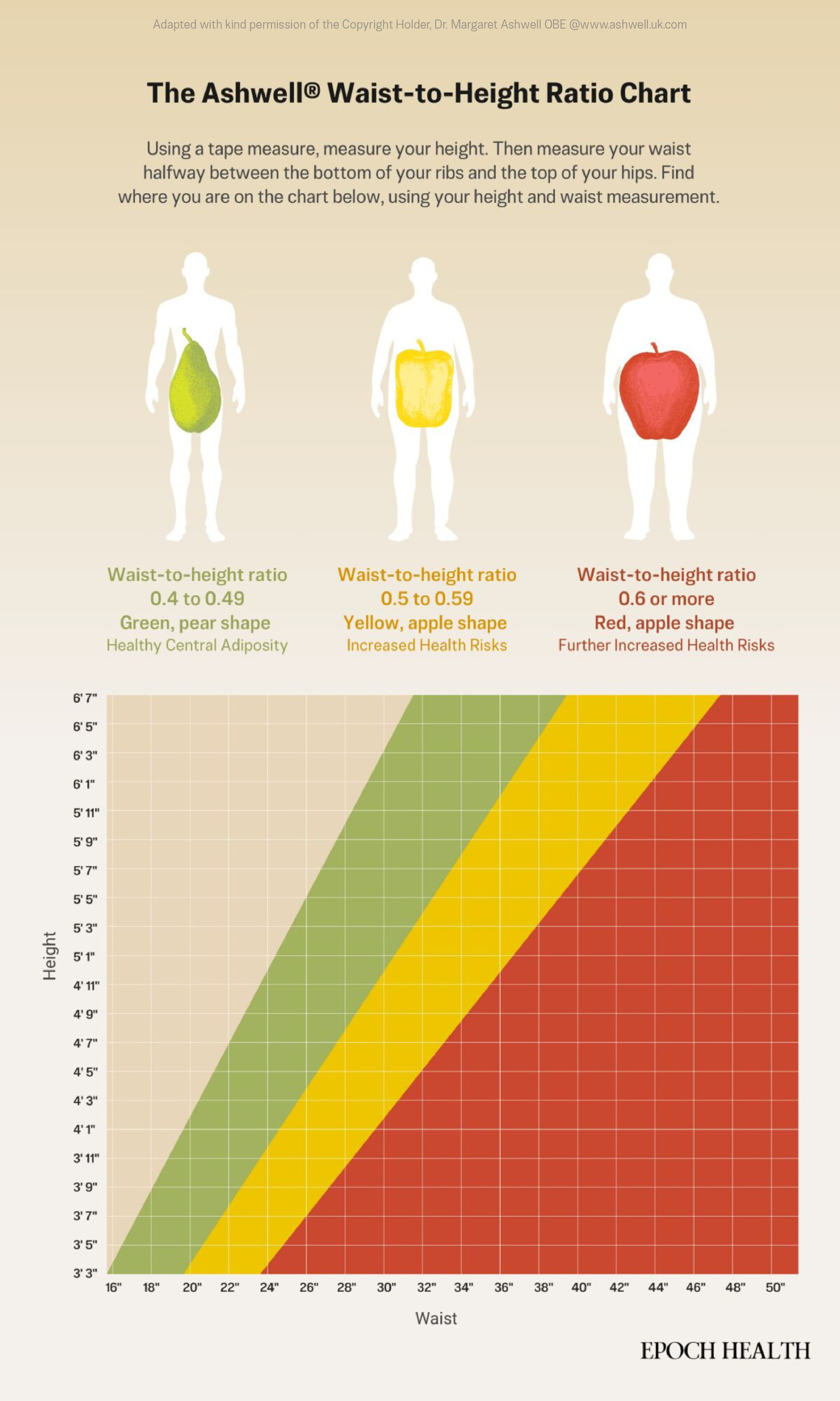
If you’re outside that range or would like to take a few inches off your middle, going about it is exactly the same as losing any other type of fat, Ashwell said.
“Eat fewer calories than you use up, making sure that you restrict your diet in a healthy, balanced way,” she said. “Actually, there is evidence that visceral fat is lost first.”
4. Cortisol
Cortisol is a steroid hormone released in response to physical and emotional stress. In short bursts, it’s healthy and necessary, as it sharpens focus and provides energy when we need it most. But when cortisol levels are chronically high or poorly regulated, they can cause long-term wear and tear on the body, a process called allostatic load.
The downstream effects can be serious. Constantly elevated cortisol can shorten telomeres (the protective caps at the ends of our DNA), drive chronic inflammation, suppress immune function, break down muscle, raise blood sugar, increase visceral fat, and accelerate brain aging, making us more susceptible to neurodegenerative diseases. A 2017 study published in Neurology found that persistent, long-term elevated cortisol levels predicted Alzheimer’s disease up to six years before symptoms appeared.
Equally important is not just how high cortisol goes, but how it moves throughout the day. In a healthy pattern, cortisol peaks in the morning and gradually declines, reaching its lowest levels at about midnight. Unhealthy cortisol levels are those that remain low all day or become elevated at night.
Dysregulated patterns often appear years before clinical diagnosis.
Cortisol levels can be affected by lifestyle changes, and we can lower cortisol naturally by managing stress, getting enough sleep, eating a healthy diet, exercising regularly, cultivating positive relationships, and staying hydrated, as dehydration can temporarily increase levels.
Cortisol levels can be measured via blood, urine, or saliva, and although these tests are generally ordered by a healthcare provider, there are kits that you can order to measure cortisol at home. These usually involve collecting saliva—often throughout the day to track levels. These tests can help determine your levels and tell you when you may want to talk to a healthcare professional.
5. Nutrient Deficiencies
Nutrition is often overshadowed by factors such as sleep or exercise when discussing longevity, but deficiencies in vital nutrients—including vitamins, minerals, and essential fatty acids—can make us more susceptible to disease, age us prematurely, and even shorten our lives.
Matt Kaeberlein, a longevity researcher, professor of pathology, and the founder of healthspan technology company Optispan, draws a distinction between deficiency and insufficiency. True deficiency produces clinically recognizable dysfunction, he told The Epoch Times. Insufficiency—having suboptimal but not critically low levels—can quietly impair health over years or decades without triggering an obvious diagnosis.
Kaeberlein said there are a few nutrients we should pay attention to, both for their effects on longevity and because many of us don’t get enough of them. These include vitamin D, omega-3, and magnesium, which he said are among the most common and best-documented examples of suboptimal nutritional status in the United States.
Research has shown that insufficient vitamin D can shorten telomeres and increase age-related DNA damage, and that those with prolonged deficiency increase their risk of developing age-related diseases and dying prematurely. Omega-3 fatty acids promote longevity by slowing biological aging, reducing chronic inflammation, and improving cardiovascular and cognitive health.
Magnesium is essential for DNA replication and repair, reducing inflammation, supporting mitochondrial function, strengthening the cardiovascular system, and supporting metabolic health, making it crucial for living a long, healthy life.
Many Americans also fall short on potassium, calcium, and B vitamins, while B12 and iron deficiency are particularly relevant for those who avoid animal products and for perimenopausal women and adolescents, respectively, Kaeberlein said.
“The goal should be to supplement thoughtfully, based on diet, risk factors, and—when feasible—appropriate biomarker testing,” he said. “For most people, a varied, high-quality diet is the best foundation and is sufficient to meet needs for most vitamins and minerals. In general, food should come first.”
Although supplementation may be needed for some, it is best to do so after testing.
Final Thoughts
Most of these metrics don’t require a laboratory or an expensive test and can be tracked at home. All of them respond to the same fundamental interventions: regular exercise, quality sleep, a nutrient-dense diet, stress management, and consistent attention to how your body is changing over time.
For most people, it is not necessary to track every nutrient or mineral intake closely if they are eating a generally healthy diet, Kaeberlein said. A varied, minimally processed diet covers most people’s needs. Some people should pay closer attention—vegans, older adults, and those with certain health conditions or absorption issues are at higher risk for deficiencies. Key tests worth knowing about are vitamin D, omega-3 index, iron, B12, and a blood count for anemia. A doctor can help determine what’s relevant for you.
What may be more important than specific numbers of values in the moment is the trajectory—a trend moving you away from health, toward disease, and, possibly, an early death. Reliable metrics that alert us to problems before symptoms arise are a powerful tool, giving us time to make positive changes that can help us live a long, healthy life.