Editor’s Note:
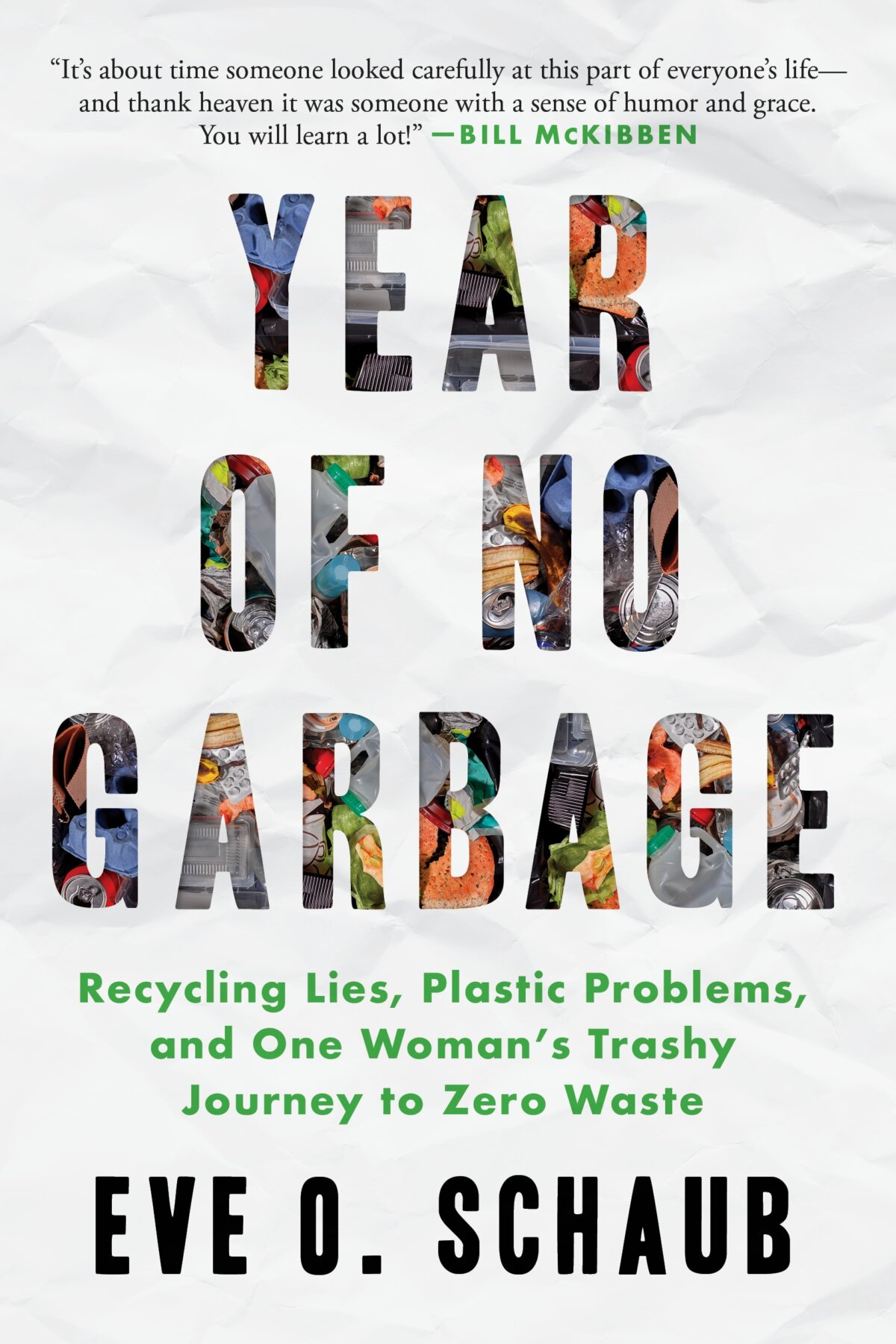
When author Eve Schaub set out on her latest of numerous projects—this time of going zero waste—she had no idea that this would be her most challenging one to date. Ms. Schaub’s children were no strangers to their mother’s odd experiments, having taken part in a year without sugar and a year of no clutter. However, becoming zero waste proved to be incredibly difficult while living in a contemporary society.
They certainly learned some important lessons to help minimize their impact on the environment along the way, such as cutting down the family’s waste from 96 gallons of trash per week, to just nine! Through trials and errors, Ms. Schaub learned that significant waste reduction is possible—and hopes that in reading her book, “A Year of No Garbage,” people will rethink their throwaway habits, and become more mindful of what they purchase in participation toward a cleaner world.
Plastic Is Not Really Recyclable
How do we define recyclable? Anyone who talks about the “circular economy,” in which materials go around and around in an eco-friendly cycle of reforming and reuse, is not—cannot be—talking about plastic. Ever. Even the very best, most adaptable plastics are ultimately irredeemable garbage.
This is because unlike glass and metal, which can be recycled infinitely, even genuinely “recyclable” plastics can only be re-formed one or maybe two times before the chemical composition degrades to the point of being utterly unusable. They will just fall apart. Then what?
I bet you can guess! They go to sit in the landfill for eternity or create toxic fumes and ash as they are burned up in an incinerator. When I learned this I realized that, when we talk about plastic, we really shouldn’t even use the word recyclable, because it does not apply.
But let’s say you’re a “glass half full” type of person and you think being able to melt down and re-form plastic once is better than nothing at all, so you go to the store and try to buy your food in recycled plastic containers to support this recycling effort.
For the most part, you can’t. And there’s a reason for that. Most recycled plastic is too dangerous to put food in. According to a report from Environment and Climate Change Canada (a department of the Canadian government): “The vast majority of plastic products and packaging produced each year and placed on the market is not suitable for processing into food grade PCR” (PCR is “Post Consumer Resin,” i.e., used plastic). [1]
Think about it: plastics don’t just contain food, they can contain all kinds of things: motor oil, drain cleaner, mouse poison … many of them things you really wouldn’t want to put in your body. And unlike glass or metal, plastic absorbs some percentage of those toxic substances and brings them along for the next application.
But I hope you haven’t forgotten about all those ten thousand synthetic chemicals, some combination of which went into the creation of those plastics in the first place, because those are there too. Put them all together in a nice chemical stew in which, well, who knows what reactions could occur, what additional new chemicals could be formed? Given these facts, perhaps it’s not actually all that surprising that a recent study of recycled plastic children’s toys concluded that they contained high levels of toxic chemicals—such as flame retardants and dioxins. Some “were found to be as contaminated as hazardous waste.” [2]
Still want to buy recycled plastics?
Nearly half of the new plastics generated each year go to create packaging. [3] No one seems to be able to tell me what percentage of packaging plastics go specifically to food packaging, but, after studying the orgy of plastic that is my local supermarket for the last year, I think it is very safe to say that it is a freaking lot. The Canadian government concludes that most plastic which has been recycled only one time isn’t safe enough to contain food without possibly poisoning people, this strikes me as one more significant blow to the idea that plastics are recyclable.
What this also means is that when we reuse or repurpose plastic, again unlike other truly recyclable materials, it does not reduce or replace the production of new products from plastic. Those products keep right on being made at the same rate, regardless. It’s the difference between “Hey, let’s make this into something we need!” and “Can we make this into anything? ’Cause we’ve gotta do something with it.”
Plus, when we hear about plastics being “recycled,” what they are almost always talking about is downcycling. If this term sounds uncomplimentary, it’s meant to. Downcycling is the process of taking a material and making it into something not as durable or functional or valuable as it was in its first life.
Maybe you’ve seen advertising for fleece jackets or parkas or shoes that incorporate recycled plastic material. Is that downcycling? What’s important to remember is that whether it is destined to be outdoor decking or a new pullover, the material integrity of the plastic is compromised in the process of being made into new things. Whether it’s construction materials or garments that are made with “recycled” plastic, they will inevitably: 1. shed plastic microfibers, 2. degrade faster than those made with virgin plastic, and 3. emit any number of synthetic chemicals—including endocrine disrupting POPs and toxic heavy metals, as well as anything weird those chemicals have inadvertently combined and formed along the way. According to Dr. Jenny Davies of Cafeteria Culture, the older a plastic, the greater a tendency it has to “leak” this cocktail of toxic chemistry. [4]
I don’t know about you, but suddenly I’m not anxious to wear a pullover made of recycled plastic bottles anymore, much less drink water from a container made from them.
Writer and sociologist Rebecca Altman recently wrote that “[plastic] recycling is a flailing, failing system.” [5]
That’s not even the worst part. The very worst part is that the plastics industry has known this all along. Yup. In the Frontline documentary Plastic Wars, they cite industry documents from as far back as the early seventies describing large-scale plastic recycling as unfeasible. Former vice president of the Society of the Plastics Industry (1978–2001) Lewis Freeman says, “There was never an enthusiastic belief that (plastics) recycling was ultimately going to work in a significant way.”
This is deeply important, so let it sink in for a moment: despite touting recycling as the solution to the ever-growing plastic pollution problem for decades now, and spending millions upon millions of dollars to promote plastic’s image, (Keep America Beautiful! Plastics Make it Possible! Give Your Garbage Another Life!) they never believed it.
Plastics Do Not Break Down—or Go Away—Ever
Think about a potato chip bag you used in third grade. The foam insert from some shoes you bought ten years ago. Cellophane heat seals from every jar of peanut butter, salsa, or cough medicine you’ve ever opened. I could easily fill a whole separate book with every plastic item I’ve personally used and discarded over my lifetime, and it’s like your own personal horror movie to realize that, unless it made its way to an incinerator, all of it is still out there, in the world. Somewhere.
That’s because plastic does not degrade. According to a report from the National Academy of Sciences: “the vast majority of plastics are carbon-carbon backbone polymers and have strong resistance to biodegradation.” [6]
As the Australian anti-plastic activist and founder of Plastic Free July, Rebecca Prince-Ruiz, puts it: “Unlike organic material such as paper, food scraps or plant matter, plastic doesn’t break down. In the environment, when it’s exposed to sunlight and the elements, it instead breaks up into smaller and smaller pieces.” Plastics don’t biodegrade because they aren’t recognized by microorganisms as food. So instead of disappearing biologically, by changing into something else, plastics disappear only to the human eye, becoming microplastics and eventually microscopic nanoplastics, even as they remain resolutely themselves.
Asking how long it takes a plastic bag to “break down”—a hundred years, three hundred years, a thousand years, never—is the wrong question. Instead, what we should ask is how long it will take that plastic to break down into microscopic granules. And those stubborn carbon-carbon polymers are still holding on for dear life, no matter where they travel.
Microscopic Plastics Are in Our Water, Air, Food, and Bodies
Just as our No Garbage Year was beginning, and before the pandemic exploded onto the world’s consciousness, for a brief moment in February of 2020 the public was transfixed by a completely different health threat: at a press conference, Senator Tom Udall (D-NM) held up a small, wallet-size rectangle.
“This credit card here,” he said, “this is how much plastic you are consuming every week.” [7] The credit card represented the five grams of plastic on average we are all consuming in things like bottled water, beer, table salt, and shellfish, [8] as well as fruit, vegetables, [9] and meat.
Microplastics have been found in 90 percent of table salt, [10] 90 percent of bottled water, [11] and 83 percent of tap water. [12] It’s not only in our food and water, however. We all breathe in about a million nanoparticles of plastic per hour. [13]
It shouldn’t have been that surprising. In 2018 an Austrian study studied poop samples of eight people from a variety of locations in Europe and Asia and found microplastics in all of them. [14] A more recent study found that baby poop contains even higher concentrations of microplastics than that of adults. [15]
I found this new information astonishing. World-altering. Let me just stop for a moment and point out that I didn’t let my kids get sealants in their molars because I was afraid of the microscopic amounts of plastic they’d inevitably ingest. According to the American Dental Association, dental sealants are made of a plastic resin composite that does contain BPA, but you get more exposure to this chemical by touching a grocery store receipt. [16] It was like I was trying to avoid a drop of rain while swimming in the ocean.
Researchers recently found “plastic particles” in the blood of 77 percent of study participants. [17] However, the story I nominate for most likely to completely freak you out? The one that found microplastics in four out of six human placentas. [18] Oh, and breast milk. Did I mention they found microplastics in breast milk? [19]
In fact, in every food, in every part of the human body, when researchers have gone looking for micronanoplastics? They have found them.
No one knows exactly what the effect of these tiny plastics accumulating in all our bodies really is. I mean, besides our bloodstream and our poop and our breast milk, where is this plastic going? Does it accumulate in certain organs?
I may never get a gold star in biology, but I know enough to know that these facts about plastic particles invading our organs, our bloodstream, our cells, and quite possibly even our brains are all extremely troubling for the future of human health, and that’s before you have factored in the toxic chemicals, the poisons, that are being carried along with them.
What Plastics Have Done to Our Health
These days many scientists are frantically engaged in the process of trying to find out what we’ve done to human health by allowing our entire society to live submerged in a chemical soup every day, breathing, eating, drinking, and absorbing chemicals from plastics. It’s difficult work, in part because in this field of research, there is no such thing as a control: there are no humans who have not been exposed to these chemicals, so there’s nothing to compare our exposed modern-day selves to. Except the past.
So let’s look at the past. Here are some of the things scientists suspect are due to exposure to classes of endocrine-disrupting chemicals like phthalates (chemical additives that make plastics soft), bisphenols (chemical additives that make plastics hard), and perchlorate (a chemical used to make plastic have less static):
- In the United States in 1975, breast cancer affected one in eleven women; nearly fifty years later it affects one in eight. [20]
- The age of first menses has been steadily dropping in young girls for decades. One study of Danish girls showed average age for first periods dropping from age 11 to 9.9 over the course of fifteen years. [21]
- Other signs of puberty in girls have been showing up even earlier. Although a landmark study from 1960 found that puberty started on average for girls at age eleven, in 1997 a study published in Pediatrics found the average age for puberty had fallen to 9.96 for white girls and 8.87 among Black girls. [22]
- The average sperm count for a Western man in 1960 was 99 million per millimeter; in 2013 it was 47 million per millimeter. This represents a 50 percent drop in semen quality in about fifty years. [23]
- The miscarriage rate has risen by 1 percent per year over the last twenty years. [24]
More than 380 million tons of plastic are currently being produced every year. And by their own admission, the plastics industry is just getting started, enthusiastically hailing the beginning of a “New Plastics Economy.” At its current rate of expansion, plastic production is projected to double by 2040. Depending who you ask, it is projected to either triple or quadruple by 2050. [25]
I think the key to making positive change on plastic is two-pronged. First, people need to be informed not once, but repeatedly, armed with facts and horrified by the imagery too (sadly, the plastic straw turtle will not be the last). They need to watch movies like The Story of Plastic, to find out what is really happening as opposed to what we are told by everyone from the packaging industry to your garbage service provider.
Second, we need to use this information to make actual legislative change, like the Break Free from Plastic Pollution Act, so that the rules are fair, consistent for everyone and reflect the truths we know.
Eve O. Schaub is a published author and speaker who writes ‘stunt’ memoirs in order to illuminate the ills of contemporary society in a relatable and engaging way.
Her first book, Year of No Sugar, enjoyed international attention including coverage on the Dr. Oz show, Fox and Friends, USA Today, The Huffington Post, The Boston Globe, The Denver Post, The New York Daily News, Everyday Health, and the Yahoo homepage, among others. In it, she convinces her two young children and husband to eat no added sugar for a year. In her second book, Year of No Clutter, she tackles her hoarding tendencies and tries to understand/undo them. Her second book has sold over 9,000 copies.
This excerpt has been adapted from “Year of No Garbage: Recycling Lies, Plastic Problems, and One Woman’s Trashy Journey to Zero Waste” by Eve O. Schaub. To buy this book, click here.