



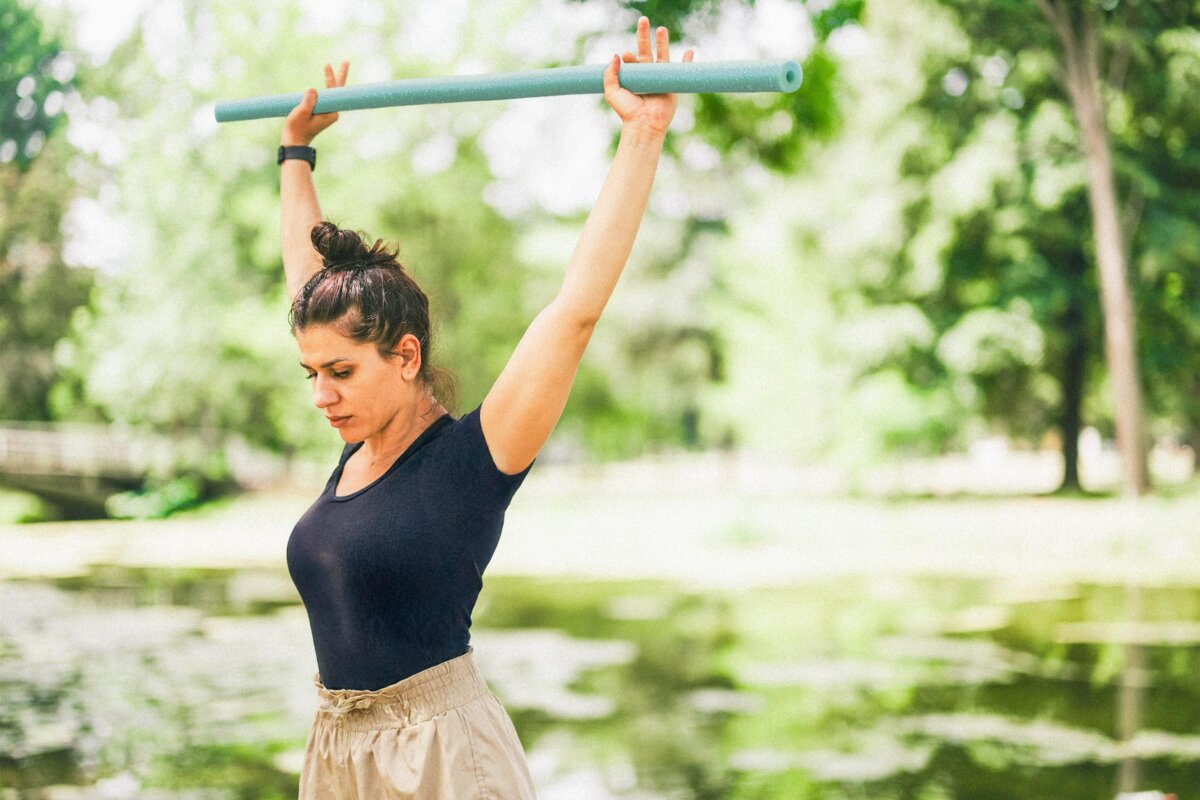
Most of us put pool noodles away in the fall and bring them back out in the spring, which makes me think the poor things feel neglected for much of the year. It makes sense, after all, because if you are not using your pool or any other water feature, you are generally not using your noodle. Your pool noodle, I mean.
But wait a minute—we can use our noodle in more than one way.
Pool noodles may seem like an odd choice to use as an implement for exercise, but there are many ways you can use them. I know, because we frequently use them in the world of rehab. Pool noodles are safe to drop, whereas other, heavier items can cause damage or harm. Though they may be “noodly,” they can provide a means to focus your grip and movement directions while allowing some degree of movement.
Noodles’ inherent flexibility prevents them from providing postural support during reaching activities, thereby shifting more responsibility to your core muscles. Finally, they are cheap and disposable, so the cost to acquire them is low if you do not already have some lying around.
I could go on, but you get the point. There are many exercises you can do with a pool noodle, both in and out of the water, and I am going to show you a couple.
5 Surprisingly Effective Exercises Using a Pool Noodle
These body-weight—well, “noodle-weight”—exercises can help strengthen your leg and back muscles and increase the flexibility of your shoulders. My patients generally tolerate these exercises well, but I recommend discussing them with your medical provider to ensure that they are right for you.
1. Noodle Slides
Noodle slides are a great postural and balance exercise. The noodle provides movement guidance but precious little actual support, and the high-low aspect makes it a real workout.
Step 1: Place a pool noodle vertically in front of you, with one end touching the ground. Place one hand directly on top. Loosely hold the side of the noodle with your other hand, just below the other hand.
Step 2: Slowly slide the side hand down the full length of the noodle until you reach the floor, and then back to the starting position. Bend your knees as you move down to reduce stress on your back and to allow your legs some exercise.
Step 3: Moving down and then back up counts as one repetition. Try to perform three sets of 12 repetitions.
Modifications: Only move your hand down as far as you can when sliding it toward the floor. Using a shorter pool noodle will increase the depth of the exercise, while a longer one can allow a greater range of motion.
Why I Like It: The high-low nature of this exercise makes it a “real” exercise. Also, the noodle very effectively guides postural movement as you move up and down.
2. Lateral Noodle Squat
Squats are always awesome, and the noodle squat is no exception. For this exercise, you will be using a noodle to both guide the exercise and add another level of movement complexity.
Step 1: Stand with a pool noodle held vertically in front of you with one end touching the ground. Lace your fingers together and cup them over the top of the pool noodle.
Step 2: Perform a lateral squat to the left, bending your left knee while straightening your right knee. As you do, tilt the pool noodle in the direction of your lateral movement without taking it off the ground or letting it slide—only allow it to pivot.
Step 3: Return to the starting position and repeat the movement on the other side. Moving into the squat and then returning to the starting position counts as one repetition. Try to perform 15 squats per side.
Modifications: If you cannot go down very far when moving into a squat, just move down as far as you can. Stand close to something you can stabilize on if you struggle to maintain your balance when moving into or out of squatting.
Why I Like It: Lateral noodle squats are great leg strengtheners and double as a balance workout.
3. Overhead Noodle Squat
The overhead noodle squat adds a balance component to your normal squat as your arms are straight overhead.
Step 1: Stand with your feet hip-width apart. Hold a pool noodle in both hands, horizontal to the ground.
Step 2: Lift the noodle straight over your head and slowly squat down until your hips and knees are at 90 degrees of flexion. Be sure to keep your head up and back straight. Keep your arms straight up as you move, and sit back into the squats to keep your knees from moving out in front of your toes as you bend.
Step 3: Squatting down and returning to standing counts as one repetition. Try to perform three sets of 10 repetitions, feeling free to modify sets and repetitions to suit your needs.
Modifications: Only squat down as far as you comfortably can. Stand next to something you can use to stabilize yourself on if you struggle with your balance during these squats.
Why I Like It: Having your hands over your head while squatting intensifies the movement. Where lateral squats focus on balance during side-to-side movement, this one focuses on front-to-back movements.
4. Noodle Around the World
Your shoulders are capable of a circular motion called circumduction, and although it is a wonderful movement, the shoulders require regular maintenance to maintain their full range of motion. The around-the-world stretch is a robust shoulder exercise that delivers exactly what your shoulders need, aided and abetted by your trusty pool noodle.
Step 1: Hold a pool noodle horizontally with both hands, well separated, and palms down.
Step 2: Keep your elbows straight and swing the noodle in an arc over your head until you reach as far behind you as you can, then return to the front.
Step 3: Moving over your shoulders and then back to the starting position counts as one repetition. Try to perform three sets of 12 repetitions.
Modifications: Many people cannot move their arms in a complete arc, and that’s okay. Just do what you can at first, because many people improve over time.
Why I Like It: The around-the-world stretch is a great overall shoulder exercise, even if you cannot move your arms in a full arc.
5. Noodle Twist
This vertebral mobility exercise is good for getting your shoulders moving. As with the other noodle exercises, one of the chief benefits is that it helps guide your movements. Take it slowly and carefully, and your shoulders will love these exercises.
Step 1: Hold a noodle in your hands so that it is straight out in front of you horizontally, with your hands about a foot apart.
Step 2: Keeping your body still and your elbows straight, slowly rotate the noodle clockwise until it becomes vertical. Hold position for approximately three seconds.
Step 3: Next, slowly rotate back to the starting position before rotating counterclockwise back into vertical again. Performing the turn in one direction counts as one repetition. Try to perform 30 total rotations (15 per side).
Modifications: Only move left and right as far as you comfortably can. Spread your legs a little further apart if you struggle with balance. You can place cuff weights on your wrists if you want to intensify this exercise.
Why I Like It: This is a great exercise for maximizing the flexibility and range of motion of your shoulders.
Noodling around may seem whimsical, but make no mistake: These exercises are part of a routine we have patients perform in the clinic and are highly effective when performed as a routine. I hope you find them beneficial.
About the Fitness Model: Aerowenn Hunter is a health editor and fitness model for The Epoch Times. She is an accredited yoga therapist with three decades of teaching experience.