



I get it. You’re busy and have a lot going on, and there doesn’t seem to ever be enough time to do everything you want and need to do, especially when it comes to exercising. It’s easy to prescribe an extensive exercise set or an exercise course that unfolds throughout the week in a one-thing-after-another format that, yes, is highly effective but that you don’t always have time to do.
Research detailing how effective routine exercise is abounds, and at the end of the day, we can get a substantial benefit for our bodies if we can find just a little bit of time for exercise.
What, exactly, is a compound exercise, you ask? A compound exercise is a movement that engages multiple muscle groups at the same time and involves more than one joint. The exercises I’ve chosen for this routine involve moving many joints simultaneously. The benefit? They’re highly efficient, so you get a maximal return for the time you spend doing them. They also train your body in functional movement patterns that can benefit your everyday movements.
5 Classic Exercises With Timeless Benefits
To make this exercise set available to as many people as possible, I’ve modified the exercises to use a dowel stick—brooms, mops, and other long-handled items can work well, too—instead of a traditional bar. Of course, if you do have access to a bar, you can certainly go for that.
These five exercises are well-known for their functional benefits, and my patients tolerate them well in the clinic. I suggest that you speak with your medical provider to ensure that they are right for you.
1. Dowel Back Squat
Squatting movements are superb, and I frequently recommend them. The classic back squat is one of the most iconic movements you’ll ever see in a gym, and you can discover everything good about it in the privacy and comfort of your own home.
Step 1: Hold a dowel in both hands. Place your feet slightly wider than hip-width apart with your toes slightly outward. Bring the dowel stick over your head and rest it symmetrically on your shoulders.
Step 2: With your back straight and your head up, keep the dowel in position as you move into a squat. Be sure to sit back into the squat by moving your hips back as you descend, to keep your knees from going out in front of your toes. Try to move into the squat until your knees and hips are at 90 degrees of flexion. Rise back up from there into the original starting position.
Step 3: Moving down and then back up counts as one repetition. Try to perform three sets of 12 repetitions. Be sure to maintain good form during this exercise; it’s easy to start slumping over and lapse into poor form.
Modifications: Can’t move down far? Only move down as far as you can. Add weight to the bar (strap weights work well) if you want to increase the exercise’s difficulty.
Why I Like It: You’d find it hard to beat the classic back squat for strengthening your quadriceps and gluteal muscles, and the back squat also serves a secondary role in strengthening your balance.
2. Dowel Deadlift
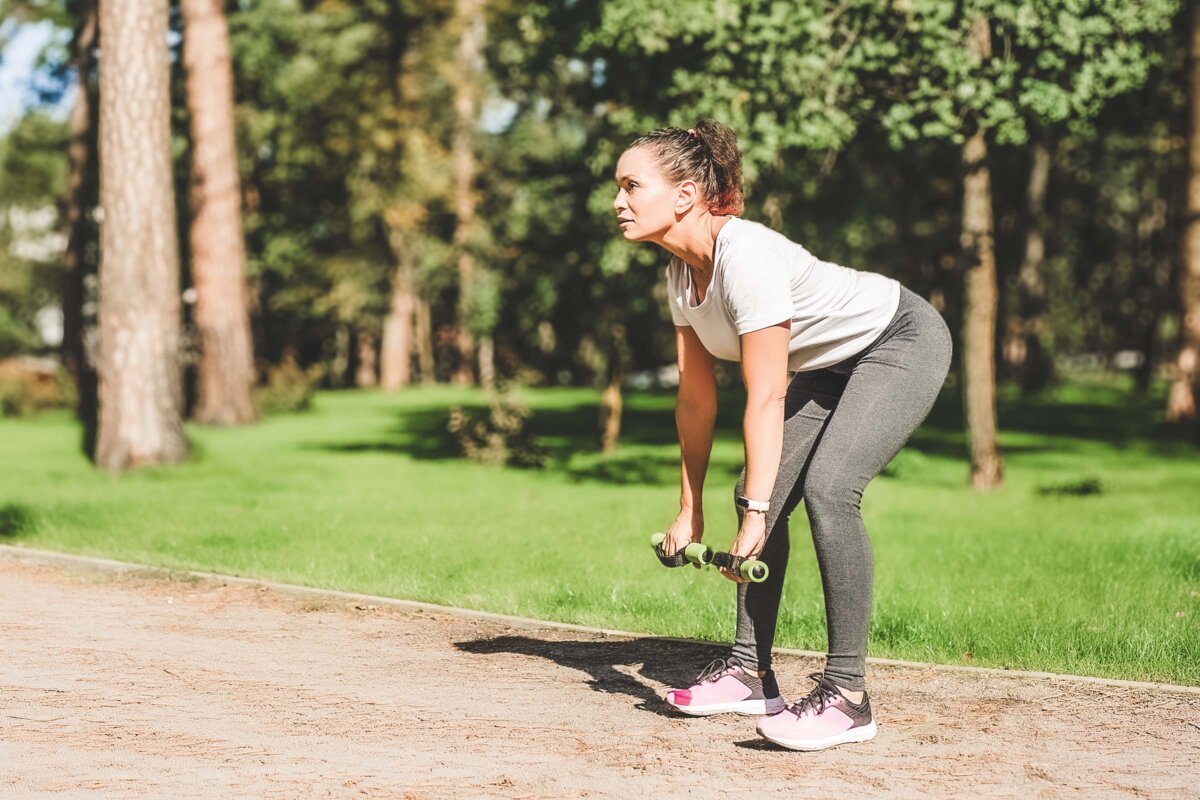
The deadlift is a wonderful way to engage your back and core muscles, and just about everything else. It’s a great exercise to build strength and work on your back mobility.
Step 1: Hold a dowel in both hands, with your palms facing inward. Place your feet approximately hip-width apart.
Step 2: Bend your hips and knees as you move the bar down the front of your legs and to the top of your feet. Keep your back straight and long as you descend. Once you move all the way down, slowly stand up and bring the bar back to the starting position.
Step 3: Moving all the way down to your feet and then back up counts as one repetition. Try to perform three sets of 12 repetitions.
Modifications: Add weight to the bar to increase the effectiveness of the exercise. If you can’t make it all the way down to your feet, just lower the bar as far as you can before returning to standing.
Why I Like It: The classic deadlift is a true whole-body compound exercise, working on everything from quadriceps, hamstrings, and gluteal muscles all the way up to the muscles in your shoulder girdle. It also gives a lot of love to your core musculature.
3. Dowel Bench Press
The bench press is an upper-body strength exercise that primarily targets your triceps and pectorals. I find that it also helps strengthen your core muscles. Because most people don’t have access to a proper weightlifting bench, I’m going to take this exercise decidedly old school and have you perform the press movement from the floor, or you can improvise as our demo does—just make certain the surface is stable.
Step 1: Lie on your back and hold the dowel in both hands at chest level with your palms facing down.
Step 2: Slowly push the weight straight up toward the ceiling until your elbows are straight. Immediately lower the dowel down slowly.
Step 3: Pushing the bar up and then returning it back down to the floor counts as one repetition. Try to perform three sets of 12 repetitions.
Modifications: If you’re using a proper weight bar and want to increase the challenge, add some weights. Feel free to modify the sets and repetitions to suit your needs. If you can’t push all the way up, just push up as far as you can.
Why I Like It: This is a classic chest-strengthening exercise that becomes extremely stable when performed from the floor level.
4. Dowel Overhead Press
The classic overhead press is a surefire winner on all accounts. It’s a great exercise for your shoulders, providing great resistance for your deltoids and trapezius muscles, as well as your triceps muscles.
Step 1: In a sitting or standing position, hold a dowel stick at collarbone height with your palms facing outward.
Step 2: Slowly push the dowel straight up overhead until your elbows are straight before slowly lowering it back down into the starting position. Be sure to bring the stick straight over the top of your head when pushing up, and avoid angling your arms forward.
Step 3: Pushing the weight up and then lowering it back down counts as one repetition. Try to perform three sets of 12 repetitions.
Modifications: Feel free to modify sets and repetitions to suit your needs. Add strap weights to the bar if you want to make it more challenging. If you can’t get your arms all the way up, just push them up as far as you can.
Why I Like It: This is a great exercise for shoulder strengthening, and also imparts a great benefit for overall shoulder mobility.
5. Dowel Pullover
One of the classic five exercises is the pull-up, and I highly commend it for its effectiveness. However, it’s not necessarily an exercise that’s easily accessible for people at home. Although there are devices that hang from doorways, these can be fiddly and difficult to use for many people. Elastic bands can be used with high anchor points, but aren’t practical for everyone.
Thus, let me introduce the dowel pullover, which can be performed right after the floor bench press. True, it’s not in the same league as the pull-up, but almost everybody reading this will be able to do it.
Step 1: Lie on the floor or a bench. Hold the dowel in the same position as the earlier bench press exercise. Push the weight straight up until your elbows are straight. Slowly lower the dowel overhead until your hands touch the floor or your arms are parallel to the floor. This is the starting position.
Step 2: Keeping your elbow straight, lift your arms until the dowel is straight up overhead. Lower it back down to the floor, keeping your elbows straight. This counts as one repetition.
Step 3: Try to perform three sets of 12 repetitions.
Modification: As with other exercises, feel free to add weight to make the activity more challenging. Can’t go all the way down to the floor with your hands? Lower them down as far as you can. As you stretch into the movement, you should gain some range of motion.
Why I Like It: This exercise is a reasonable alternative to the pull-up and is accessible to most people.
With some modifications, these exercises let you reap the benefits of the five classic compound exercises. Quick to perform, they are easy to fit into your lifestyle. Robust in what they deliver, they are highly effective, which is why they are regarded so highly by millions of people. I recommend performing them three days per week, or ideally, up to five times per week. I’m sure that you’ll like them, and I hope that they work well for you.
About the Fitness Model: Aerowenn Hunter is a health editor and fitness model for The Epoch Times. She’s an accredited yoga therapist with three decades of teaching experience.
Views expressed in this article are the opinions of the author and do not necessarily reflect the views of The Epoch Times. Epoch Health welcomes professional discussion and friendly debate. To submit an opinion piece, please follow these guidelines and submit through our form here.