



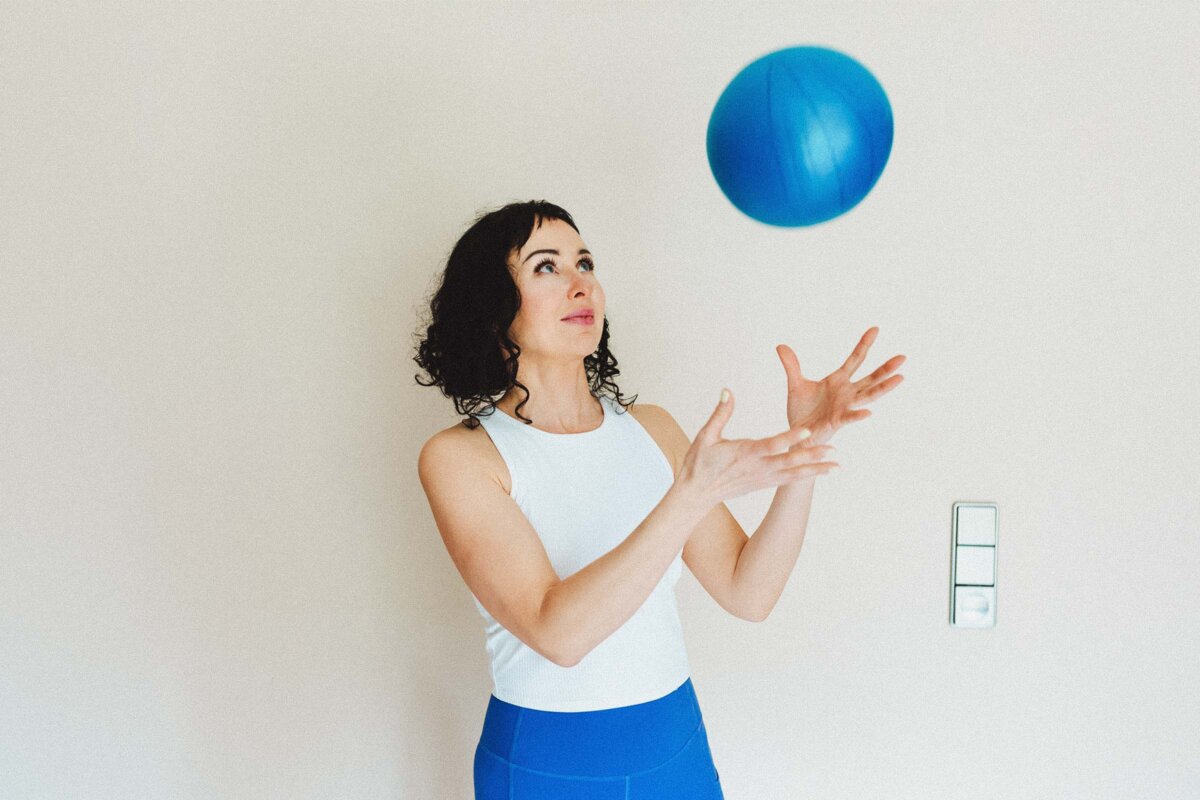
Object-directed exercises and activities are big in the rehab world. Providing an object to work with can often increase task accuracy, making tasks more effective and successful. Sometimes, getting patients to focus on proper handling of an object can help them master the mechanics of an activity faster than just trying to steer them through the movements alone.
Clinically, weights and elastic bands are common, but we also use cones, bean bags, balls, dowel sticks, pegs, hoops, and land mines. OK, I’m just kidding. We don’t always use bean bags. Seriously, we use a lot of equipment and get great results when we do.
I find ball exercises particularly effective for anyone because they lend themselves to many variations and many people demonstrate a natural ability to handle them well.
5 Beneficial Exercises Using a Small Ball
These five exercises can give you a great workout with nothing more than a small ball and a bit of effort. They definitely work on endurance and strength, and they also focus on balance, which I love because good balance equals better safety. These exercises work well for my patients, and I like them, too, but I suggest that you discuss them with your medical provider to ensure that they are right for you.
1. Russian Twist
Among the great core-building exercises, the Russian twist stands proud. It works on almost all of your anterior muscles to some degree, and the balance components also train your body parts to work together.
Step 1: Sit on the floor, with your knees bent and your feet flat on the floor. Hold the ball in both hands.
Step 2: Lean back, slightly extend your knees, and lift your feet off the floor. Allow a few seconds for your balance to stabilize.
Step 3: Rotate right to touch the ball to the floor beside your right hip while still holding it in both hands. After touching the ball to the floor on your right, rotate left and touch the ball to the floor on that side. Take approximately one second to perform each movement and try to keep your feet in the air at all times.
Step 4: Touching the ball to the ground counts as one repetition. Try to perform three sets of 30 repetitions.
Modifications: Put your feet down as you need or want to for balance or just to rest. To increase the challenge, you can straighten your knees even further while keeping your feet up. You can also use wrist cuffs or a weighted ball to increase resistance if you so desire. If you’re really feeling spicy, you can add weights to both your arms and legs at the same time—but don’t overdo it.
Why I Like It: The Russian twist is a great sustained-strain activity, and once you get the hang of it, it can bring powerful benefits.
2. Supine Straight Leg Lifts
Leg lifts are great for strengthening your core musculature and also focus heavily on your hip flexors, including the iliopsoas, which is the primary hip flexor and comprises the psoas major and iliacus muscles. Healthy, safe walking requires strong hip flexors.
Step 1: Sit on the floor with your knees straight and your feet side by side. Place a ball between your feet and hold it securely with your legs.
Step 2: Lie back on the floor with your arms by your sides, palms down.
Step 3: Tighten your abs and core muscles, then lift the ball straight up as far as you can or until you reach 90 degrees of hip flexion. Be sure to keep your knees straight—or as straight as you can—during the ball lifts.
Step 4: Lifting the ball up and then placing it back down counts as one repetition. Try to perform three sets of 15 repetitions.
Modifications: If you can’t bring your legs all the way up into 90 degrees of flexion, lift them as far as you can. You can add ankle weights or use a weighted ball to make the exercise more challenging. You can also perform this exercise sitting in a chair, although you won’t have access to as much range of motion.
Why I Like Them: Straight leg lifts focus heavily on your core and hip flexors and have an outsized positive effect on the mechanics of walking.
3. Tabletop Hold/Crunch
Another great core exercise is the traditional crunch. Adding a ball to the crunch laser-focuses the movement and allows you to deeply dial in on your core muscles.
Step 1: Lie on your back on a firm, supportive surface with your knees bent to approximately 90 degrees; hold a ball in both hands.
Step 2: Keeping your knees bent, bring them above your hips. Slowly reach up, place the ball between your knees, and hold it firmly with your legs.
Step 3: Keeping your legs in position, slowly lie back and reach your arms overhead. Next, using your core muscle, hinge back up, retrieve the ball from between your legs, and move your arms back overhead while holding the ball. When you come back up again, place the ball between your knees again. The rhythm alternates between reaching up to retrieve the ball from between your knees on one repetition and returning the ball between your knees on the next.
Step 4: With each crunch counting as one repetition, try to complete three sets of 15 crunches.
Modifications: Feel free to modify sets and repetitions to make them work best for you. You can add cuff weights or use a weighted ball to make the activity a little more challenging. If you can’t lie all the way down and move back up, decrease how far you go down to make it easier to rise back up again.
Why I Like It: Adding ball mobility focuses the activity more closely and encourages more accurate postural movement.
4. Squat Touch
The squat touch exercise is a great leg strengthener that also promotes shoulder flexibility. If you do this one enough, you’ll be able to stand much more easily, and walking up stairs will be a breeze.
Step 1: Stand with your feet approximately three feet apart and hold a ball in both hands with your elbows extended. Rotate your feet approximately 45 degrees outward.
Step 2: Slowly squat down and touch the ball to the floor. Let your knees bend out in the direction your feet are pointing. Rise back up and push the ball straight up as high as you can overhead before returning to the starting position.
Step 3: Each time you touch the ball to the floor and then push it up overhead counts as one repetition. Try to perform three sets of 15 repetitions.
Modifications: If the full range of motion is too much, move the ball down and up as far as you can without strain. You can add cuff weights or use a weighted ball to increase resistance for more of a challenge. Also, feel free to modify the sets and repetitions to make this activity work best for you.
Why I Like It: The squat builds powerful muscle, and the overhead press offers excellent shoulder range of motion.
5. Single Leg Balance
OK, so you’re tougher now, but are you well-balanced? The single-leg balance exercise will work you just as hard as the others, but instead of working on rote muscular strength, you’ll be working on balance.
Step 1: Stand with your feet approximately one foot apart and hold a ball in front of you in both hands with your elbows straight.
Step 2: Next, lift your right leg off the floor and bend your right hip to 90 degrees. Hold here for a few seconds to allow your balance to stabilize. It’s OK to put your foot back down if you need to at first—or any time during the activity, for that matter.
Step 3: Slowly move the ball to your left with your arms while holding your lower body still. Follow the movement with your head. Once you move as far to the left as you can, move toward the right as far as you can. Overall, this is a side-to-side activity.
Step 4: Moving in one direction and then the other counts as one repetition. Try to perform three sets of 20 repetitions on each leg.
Modifications: If you struggle with your balance during this activity—and most of you will—you can stand against a piece of furniture or a counter to help stabilize, which will keep you from having to constantly put your foot back down. Don’t rely on this, however, because I want you to train your body to balance better.
Why I Like It: I’ll tell you straight—this is a challenging exercise and will take some time to master. Keep at it, however, and you can reap definite benefits for balance—essential for mobility at any age.
You’ll have a ball performing these exercises, literally. Seriously, these exercises accomplish two very critical aspects of a successful workout routine: They’re both fun and highly effective. Try them, because I think you’ll like them. I suggest doing them at least three times per week, and ideally five times. Good luck, and I hope they serve you well.
About the Fitness Model: Aerowenn Hunter is a health editor for The Epoch Times. She’s an accredited yoga therapist with more than three decades of teaching experience.
Views expressed in this article are the opinions of the author and do not necessarily reflect the views of The Epoch Times. Epoch Health welcomes professional discussion and friendly debate. To submit an opinion piece, please follow these guidelines and submit through our form here.