



We’ve recently seen an increase in patients with knee pain in the clinic. It’s a very common presentation caused by a variety of diagnoses and conditions, and it can put a severe crimp in your mobility and functional independence.
Knee pain is a deep, cloying kind of hurt that vexes you during movement and haunts you even when you try to sit and rest—from sharp and piercing to a dull, pulsing ache. These patients often do not have knee pain or pathology as a primary diagnosis—every one of them deals with it as a secondary diagnosis.
In therapy, we address knee pain with a combination of movement and strengthening when overt pathology does not preclude engaging those joints. Mobility is excellent for lubrication and keeping joints limber and warm, while strengthening is excellent for maximizing joint cohesion and robustness. I like including a mix of both to ensure that we lovingly and safely address them without causing overt pain or distress.
What are these exercises? Glad you asked.
5 Knee-Friendly Exercises
The following exercises can help with joint pain while being easy on your knees. They provide flexibility and strengthening and are within the capabilities of most people. My patients tolerate them well, but I suggest you consult your medical provider to ensure they are right for you.
1. Supine Leg Slides
Supine leg slides are a great way to get the party started. These mild movements, performed with no more resistance than the weight of your lower leg, provide both mobility and joint warming in a tidy package.
Step 1: Lie down and place your legs straight out.
Step 2: Slowly pull your right heel up toward your glutes as far as it comfortably can, then slowly lower it back down. Repeat on the other side.
Step 3: Moving your leg up and then back down counts as one repetition. Try to perform three sets of 15 repetitions per side. You can either alternate left and right sides as you work through the sets or perform all repetitions on one side and then the other. I recommend trying both to see which works better for you. Modify the sets and repetitions as needed to make the exercise work best for you.
Modifications: If you cannot move your legs all the way out straight, just move them up as much as you can. Feel free to modify the sets and repetitions to make the exercise work best for you.
Why I Like It: This warmup is simple and effective, and it can prepare your knees for further exercise. Even better, you can perform it before you even have to get out of bed and start putting weight on your knees.
2. Seated Leg Extensions
Seated leg extensions are a natural transition from the supine leg slides. Both move the knee, but the seated leg extensions add a bit of resistance.
Practice Tip: If you performed the last exercise in bed, you can perform this one at the edge of the bed.
Step 1: Sit toward the back end of a solid chair with a straight posture. Let your feet hang straight down.
Step 2: Slowly extend your right knee straight out, then lower it back down.
Step 3: Lifting your leg way up and then lowering it back down counts as one repetition. Try to perform three sets of 15 repetitions per leg. You can perform all movements on one side, and then the other, or you can alternate between your right and left legs as you move through the sets.
Modifications: As with the supine leg slides, move your leg only as high as you comfortably can.
Why I Like It: This exercise is a great segue from the supine leg slide and adds an increased focus on activating your quadriceps.
3. Chair Squats
Now that we’ve warmed up your knees, let’s move into a dedicated weight-bearing activity to strengthen your quadriceps and gluteal muscles and increase structural strength in your knees.
Step 1: Sit at the front of a chair with your feet hip-width apart and your arms reaching straight forward.
Step 2: Shift your weight forward and slowly stand up, lowering your arms as you rise.
Step 3: As soon as you move fully into standing, slowly return to sitting while raising your arms straight forward again. Instead of sitting all the way down and relaxing, however, only touch down lightly before rising back up to keep your muscles from losing contraction force.
Step 4: Standing up and sitting back down counts as one repetition. Try to perform three sets of 15 repetitions.
Modifications: If full squats are currently out of your range, feel free to perform partial squats. You can also practice sitting all the way down and resting for a few seconds before standing back up to give your muscles a tiny bit of rest before moving into the next repetition.
Why I Like Them: Chair squats are a great power-building exercise, but their slow, hydraulic movement pace and closed-chain nature make them easy on the knees.
4. Hamstring Curl
This curling exercise is an excellent way to engage your hamstrings while standing. Weak hamstrings can lead to pain around the knee joint, so it makes sense to strengthen and maintain them.
Step 1: Stand with your feet side by side. I recommend standing behind a chair for stability.
Step 2: Bend your right knee and slowly bring your foot up behind you as far as you comfortably can. Be sure to keep your thigh straight up and down, rather than lifting it as if you were marching. As soon as you move your foot up as high as you can, slowly lower it back down and repeat the movement.
Step 3: Bending your knee and raising your foot counts as one repetition. Try to perform three sets of 15 repetitions per side. You can perform all repetitions on one side and then the other, or you can alternate sets from right to left as you go, to allow your legs to rest between sets. Be sure not to speed up as you move through your sets.
Modifications: As mentioned before, stand behind a chair or in front of a counter to support your balance as needed. If you cannot move your knees very far into flexion, just move them as far as you can. Feel free to modify your sets and repetitions to make the exercise work best for you.
Why I Like Them: Hamstring curls not only provide excellent mobility for your knees, but also provide very focused strengthening for your hamstrings.
5. Standing Hamstring Stretch
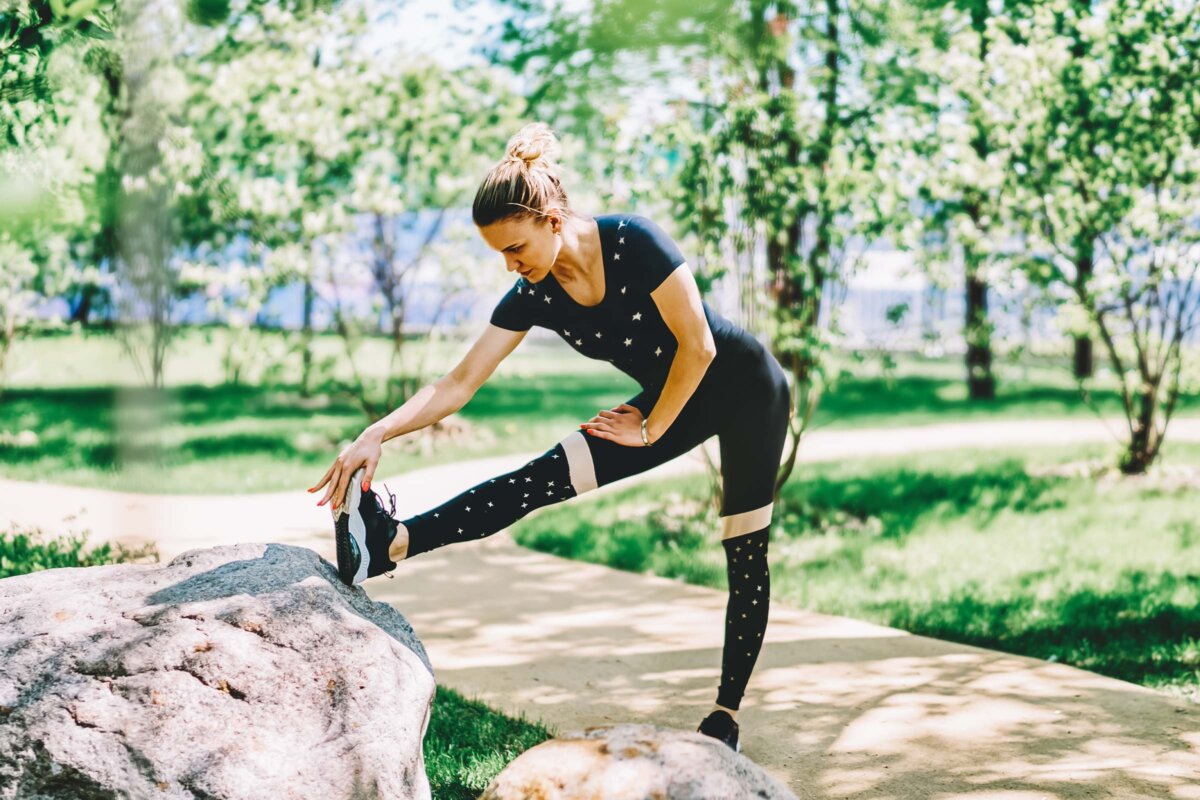
Although it’s true that weak hamstrings can contribute to knee pain, tight hamstrings can wreak havoc. The standing hamstring stretch follows the hamstring strengthening exercise because it stretches the hamstrings while they’re warmed up, allowing you to enter a deeper stretch with less resistance.
Step 1: Stand in front of a chair, facing the seat from about three feet away. It can be helpful to stand parallel to a counter or wall to help with your balance if needed.
Step 2: Slowly bring your right leg up and place your heel in the middle of the seat with your right knee straight.
Step 3: Keeping your knee straight, slowly lean forward and slide your hands down your right leg until they are just past your knees. Pay attention to your hamstring muscle and move down only as far as you comfortably can. Hold the stretch for approximately 15 seconds, then return to the starting position and repeat on the other side.
Step 4: Moving into and then out of the stretch counts as one repetition. Try to perform 10 repetitions per side.
Modifications: As mentioned, stretch only as far as you comfortably can. Often, you can gain more range over time as you loosen your hamstrings, so there’s no need to push yourself too hard at first (or ever).
Why I Like It: This is a very direct, strong stretch for your hamstrings that’s easy to control. Be careful: It’s strong medicine, and you do not want to overdo it at the onset.
Combined, these exercises can help soothe tired, painful knee joints while also helping protect your knees from exercise-related pain. They can be performed three times per week to good effect, and optimally, five times per week. Good luck, and I hope they serve you well.
About the Fitness Model: Aerowenn Hunter is a health editor for The Epoch Times. She’s an accredited yoga therapist with more than three decades of teaching experience.
Views expressed in this article are the opinions of the author and do not necessarily reflect the views of The Epoch Times. Epoch Health welcomes professional discussion and friendly debate. To submit an opinion piece, please follow these guidelines and submit through our form here.