



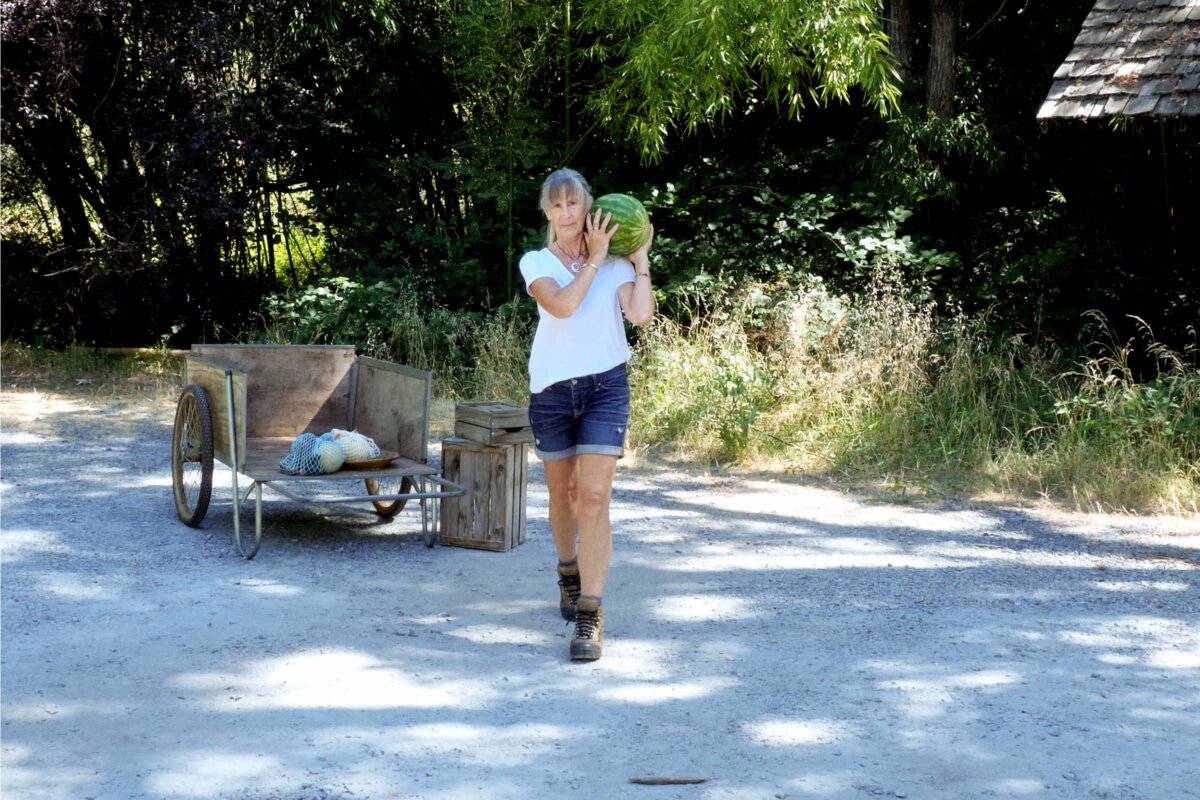
As the crops come in, farmers are busily harvesting and carrying them to market. It’s also a great time for a therapist like me to give you some nice farmer’s carry exercises to “carry” yourself into better health.
The farmer’s carry is an undervalued whole-body exercise that strengthens your core, improves balance, and corrects posture. You cannot deny that farmers have done something right.
The best thing about the exercise? You can eat your workout equipment afterward!
We cannot let those farmers have all the fun, after all.
5 Farmer’s Carry Exercises
Summer is the time for veggies, not vegging out. These exercises can help you gain real strength in a real manner. Using unconventional items for resistance adds some variability and, in my opinion, offers a great alternative to standard gym equipment, which, although effective, can at times become somewhat mundane.
These exercises work well for my patients—and we get a lot of laughs and stories out of them—but I suggest you consult your medical provider to ensure they are appropriate for you. They will probably tell you to “carry” on.
1. Melon Goblet Carry
The traditional goblet carry is an excellent exercise that places weight high on your chest, with your hands supporting it in front of your body.
Step 2: Without letting the melon rest against your chest, begin slowly walking while maintaining an upright posture. Also, keep your arms from resting on your body. You want a sustained contraction through your shoulders.
Step 3: Try to walk for one minute while holding the melon in position for each set, and attempt three sets.
Modifications: Instead of picking the melon up off the ground, you can place it on an elevated surface and pick it up from there. And remember: The bigger the melon, the bigger the challenge, but make sure you can still handle the weight.
Why I Like Them: Goblet carries pack some serious core stability, improve posture, and train your body to work as a coordinated whole. Your arms are definitely involved, but your trunk does the lion’s share of the work.
2. Overhead Cantaloupe Carry
All overhead carry exercises are excellent in general, and I can think of only one way to make them even better: add a cantaloupe! Seriously, the fruit’s weight adds significant resistance, and the shape forces you to maintain a steady contraction throughout the exercise to keep control.
Step 2: Begin walking while maintaining the cantaloupe overhead, and try to do so for one minute. The overhead portion of the exercise is tough, so it’s OK if you cannot hold the cantaloupe overhead for the whole time. Just hold it as high as you comfortably can, especially if you have shoulder pain. Even a few inches of elevation will give you a good workout.
Step 3: Try to perform three one-minute sets.
Modifications: If a cantaloupe is too heavy, you can use a smaller fruit, such as a grapefruit. If you cannot quite push your arms straight up and lock your elbows, push your chosen fruit up as high as you can comfortably manage.
Why I Like Them: There’s a hidden benefit to overhead weighted carries—they can help improve your balance. Holding a weight high overhead as you walk (or as high as you can) forces your body to constantly adjust to the many small balance shifts you experience.
3. Bilateral Tomato Carry
Tomatoes are biologically fruits, functionally vegetables, and totally tasty. Carrying them bilaterally will focus on your deltoids, traps, and forearms while boosting total-body and grip strength and correcting postural imbalances.
Step 2: Walk for one minute per set, and try to perform three sets.
Modifications: If your shoulders do not want to go all the way up to a T-pose, just bring your arms as high as you can. There’s a lot of variability between shoulders, and some just do not go up as far as others. And please, if anybody laughs at you when you are doing this exercise, resist the temptation to throw the tomatoes at them. Also, if you choose to use bags for this exercise, you can technically use any veggies, such as onions or potatoes.
Why I Like Them: By focusing directly on your deltoids, bilateral carries strengthen the muscles that move your arms forward and to the sides.
4. Double Farmer’s Carry
The double farmer’s carry puts weighted goodness in each hand and works your body symmetrically. The great thing about this exercise is that you can add and remove weight as you experiment with what works best for you.
Step 2: Hold one bag in each hand with your arms slightly away from your sides so the bags do not bump into your legs as you walk. Try to walk for one minute in this position, keeping your core and shoulders engaged and your head up, looking straight ahead.
Step 3: Try to perform three one-minute walks. Feel free to increase or decrease your walking time to best suit your needs.
Modifications: If you want more resistance, add more weight to the bags; conversely, reducing the weight can make the exercise easier. You can also carry the bags with your elbows bent to increase the difficulty.
Why I Like It: The classic farmer’s carry has its own fan club for good reason: It provides an excellent workout for your core muscles, and I especially like it for how it strengthens the postural muscles in your back. A stronger back means a stronger posture.
5. Watermelon Shoulder Carry
It’s time to get pumped with a watermelon. Shoulder carry exercises challenge your core musculature through asymmetrical weight-bearing; your trunk does the work, and your arms are elevated into a good amount of shoulder flexion.
Step 2: Try to perform this walk for one minute, then repeat the movement on the left side. Try to perform three one-minute sets per side.
Modifications: You can place the watermelon on an elevated surface and lift it from there if you struggle to pick it up off the ground. It’s OK to get someone to help you with this, because it can be a little tricky until you get the hang of it. Some people struggle to balance a watermelon on their shoulders, and my solution is to use a big ole bag of potatoes instead, which drapes over your shoulder more securely.
Why I Like Them: The asymmetrical weight-bearing of shoulder carries forces your body to balance uneven loads, correcting muscle imbalances and improving spinal endurance. By resisting lateral forces as you walk, you encourage your core muscles to work harder.
Using produce for these exercises is fun and campy, but they are also highly effective, and the use of atypical equipment adds to the challenge. I think you will enjoy them, and they will certainly put your weakness out to pasture. At the end of the day, I’m open to any avenue that gets people exercising, and unconventional exercises are often a great pathway to get there.
I suggest performing these exercises at least three times per week, ideally five, whether you choose to carry produce or traditional weights. Good luck, and say “hi” to your farmers for me.
About the Fitness Model: Aerowenn Hunter is a health editor for The Epoch Times. She’s an accredited yoga therapist with more than three decades of teaching experience.
Farm use, courtesy of Foothill Roots Farm, in Meadow Vista, CA.
Views expressed in this article are the opinions of the author and do not necessarily reflect the views of The Epoch Times. Epoch Health welcomes professional discussion and friendly debate. To submit an opinion piece, please follow these guidelines and submit through our form here.