



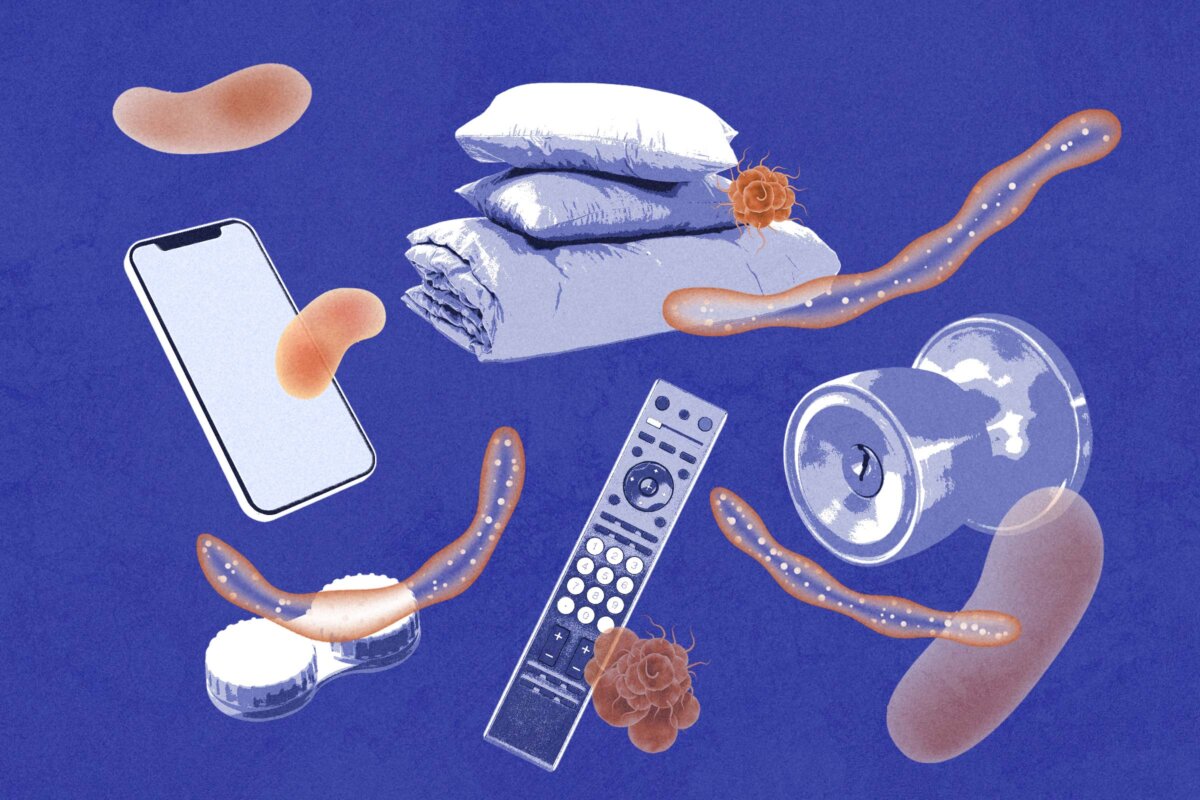
You come home from the grocery store, open the front door, settle onto the couch, and grab the remote. Before washing your hands, you may already have transferred microbes to two frequently touched surfaces.
Microbiology experts say the items deserving the most attention aren’t always the ones that look dirtiest; they’re the ones that get touched constantly and cleaned rarely. Doorknobs, remotes, keyboards, and phones accumulate more bacteria and viruses than most people assume, while the toilet bowl—long assumed to be the household’s biggest offender—is often of less concern.
Microbiology experts recommend cleaning several everyday items regularly.
The High-Touch Offenders
High-touch offenders are surfaces we touch repeatedly throughout the day, making them prime spots for transferring bacteria and viruses from one person to another.
Doorknobs
Whether in public places or at home, doorknobs are among the most frequently touched everyday surfaces—and they’re a direct pipeline for whatever you picked up while out.
After taking public transportation, shopping, or eating out, people may have touched a variety of public surfaces, picking up potentially harmful pathogens on their hands, Shao-Hung Wang, professor and chairman of the Department of Microbiology, Immunology, and Biopharmaceuticals at National Chiayi University in Taiwan, told The Epoch Times.
A 2025 systematic review of studies on doorknobs in public and healthcare settings found that about one in every six doorknobs tested positive for viral contamination. The most commonly detected virus was rotavirus, one of the major causes of gastroenteritis in children.
Remote Controls
Remote controls are often shared by several household members and may sometimes be used by guests, making their surfaces more likely to become contaminated with pathogens, Wang said.
Droplets may also land on remote controls when people cough or sneeze. Hand contact can further transfer cold viruses and other respiratory viruses to these frequently shared items.
Wang recommends first removing the batteries from the remote control, wiping away visible dirt with a slightly damp paper towel, and then cleaning the buttons and crevices with 70 percent alcohol or commercially available disinfecting wipes. The surface should remain wet for about one minute to allow proper disinfection before being left to air-dry.
Remote controls should be disinfected at least once a week. If someone in the household is ill, daily cleaning is recommended.
Before using a disinfectant, visible dirt should be thoroughly removed from the surface, as dirt may reduce the effectiveness of disinfection and allow some bacteria to survive, he added. Skipping the dirt-removal step can reduce a disinfectant’s effectiveness and help resistant bacteria survive.
Keyboards and Phones
Keyboards and phones are arguably the most contaminated items most people own.
A 2019 systematic review found microbial contamination on nearly all keyboards sampled, at a rate of 96.7 percent. A 2018 study found bacterial contamination, including Staphylococcus aureus, on 23 of the 25 mobile phones examined, though simple disinfection with antibacterial wipes cleared the bacteria from about 60 percent of the phones.
In busy places such as hospitals, schools, and offices, pathogens can attach to surfaces through respiratory droplets or hand contact. Mobile phones and laptops may therefore become portable reservoirs for microbial pathogens.
Eating while using a computer can cause food crumbs to fall onto the keyboard or into the gaps between the keys. Dust can also absorb moisture, allowing bacteria already present on the keyboard to multiply.
Some mobile phones may not be suitable for direct cleaning with alcohol. In such cases, simple cleaning can be done with a diluted neutral detergent and a soft-bristled brush, Wang said.
Computer keyboards should be dusted, wiped, and disinfected regularly. Many newer keyboards and mice are water-resistant and can be cleaned according to the manufacturer’s instructions.
The Damp, Overlooked Items
Unlike high-touch surfaces, these items become contaminated because they stay warm or damp for long periods. Moisture allows bacteria, fungi, and other microorganisms to multiply, making regular drying and cleaning just as important as frequent washing.
Bedsheets
A bed may look clean, but it can still harbor a surprising number of microorganisms.
Sweat, shed skin cells, and residual moisture from the body each night can create conditions that support the growth of bacteria and fungi.
A 2025 study showed that the lower sections of bedsheets, where the legs and feet come into contact, had the highest level of bacterial contamination. The overall bacterial load was also significantly higher on bedsheets used by men.
Wang recommends washing bedding such as bedsheets and duvet covers at least once a month. Comforters can also be placed in the sun regularly to help remove internal moisture.
Discard bedsheets or duvet covers with visible mold spots, severe yellowing, or a persistent odor that doesn’t come out after washing. These signs may indicate that microorganisms or their byproducts have become deeply embedded in the fabric, making them difficult to remove completely through normal laundering.
Towels and Bathroom Tools
Despite the toilet’s reputation, Wang says most of the microorganisms inside the bowl come from your own body. Flushing is more of a concern, since it can disperse those microbes onto nearby surfaces, including towels.
The real bathroom risk is anything that stays damp: towels, bath sponges, rinsing cups, and razors all create ideal conditions for bacterial growth in a warm, humid room.
Bathrooms are typically warm and humid, and the dead skin cells and oils left behind after bathing can create conditions that support microbial growth. If a towel is left out for a day or two, especially in hot and humid weather, it may develop a stale, oily odor. The odor is often produced by microorganisms breaking down residues left on the towel.
Items such as rinsing cups, bath sponges, and brushes can also accumulate bacteria because they often remain damp for long periods and are repeatedly exposed to droplets.
Razors, whether manual or electric, can also harbor bacteria. They regularly come into contact with the skin, shed skin cells, and microorganisms, and are often stored in humid environments.
Wang recommends keeping towels dry and washing or replacing them regularly. If a towel develops an odor that does not go away even after washing, it should be discarded.
Bathroom items such as toothbrush holders and rinsing cups should be scrubbed thoroughly with a brush, rather than simply rinsed with water.
Makeup Sponges
Many makeup sponges are made of synthetic, sponge-like materials. Although they can be washed before and after use, moisture left inside the sponge may prevent it from drying completely, allowing microorganisms to grow. Wang said the goal is to reduce microbial buildup without damaging the sponge, Wang said. After each use, rinse it with a mild cleanser.
A more thorough cleaning should be done once a week. First, wet the makeup sponge thoroughly with warm water and squeeze it to release trapped air. Then, use a mild cleanser or soap to create a lather, repeatedly squeezing and rinsing the sponge. Rinse thoroughly under warm running water until all foam is removed. After cleaning, press the sponge with a clean towel to remove excess water, then allow it to dry completely before storing it.
If the sponge develops an odor or becomes damaged, it should be discarded.
Contact Lens Cases
Many people clean their contact lenses carefully but overlook the lens case itself.
If the case is rinsed only with disinfecting solution over a long period and is not scrubbed regularly, some resilient microorganisms may form biofilms inside the case, allowing them to remain attached to the surface and build up over time, Wang said. If these microorganisms contaminate the lenses, they may be transferred directly to the eye, increasing the risk of eye irritation or infection.
He recommends pouring out the old contact lens solution every day and rinsing the case with fresh solution. Tap water should be avoided, as it may introduce microorganisms from the water supply.
After cleaning, the case should be left open in a well-ventilated area to dry thoroughly. It is also advisable to replace the lens case every three months.
Handbags
Handbags and everyday bags are often overlooked when it comes to cleaning.
During daily outings, bags are commonly placed on restaurant floors, in storage baskets, and on other public surfaces, where the bottoms may pick up microorganisms from the surrounding environment and carry them into the home.
Wang recommends regularly wiping or brushing handbags with a cleaner suitable for the material, paying particular attention to the bottom of the bag.
Why Scrubbing Matters More Than Disinfectant Alone
On frequently touched surfaces such as doorknobs, keyboards, and bathroom items, bacteria can attach to the surface and secrete sticky substances that surround and protect them, forming what is known as a biofilm. For this reason, it is usually more effective to remove surface dirt and biofilms through brushing, scrubbing, or wiping before applying disinfectant.
Chen Yo-shen, a food microbiology and molecular biology researcher in Taiwan, told The Epoch Times that biofilms can form a protective barrier that allows bacteria to hide within them.
Some bacteria may even enter a dormancy-like state, making them harder for antibiotics or the immune system to clear. As a result, they may survive for longer periods and contribute to chronic or recurrent infections. Biofilms can also make chronic wounds, such as diabetic foot ulcers and pressure sores, harder to heal and more likely to become repeatedly infected.
Common Pathogens on High-Touch Surfaces
Common contaminants found on frequently touched surfaces include Staphylococcus aureus, Escherichia coli, enterococci, Streptococcus pneumoniae, and Haemophilus influenzae, Wang said.
Staphylococcus aureus is a common potential pathogen that can cause skin infections and, in severe cases, life-threatening bloodstream infections and systemic complications.
Escherichia coli can lead to a range of infections, including urinary tract infections, neonatal meningitis, and sepsis.
Enterococci can cause endocarditis, intra-abdominal infections, and urinary tract infections.
Streptococcus pneumoniae and Haemophilus influenzae can both cause respiratory tract infections and, in severe cases, may lead to pneumonia or meningitis.
The goal is not to maintain a completely sterile environment, Wang said, but to reduce the spread of pathogens through regular cleaning and good hygiene practices, while avoiding conditions that allow microorganisms to grow.
For most people, intact skin and mucous membranes, normal immune function, and regular handwashing help prevent these bacteria from entering deeper tissues and causing serious disease.