



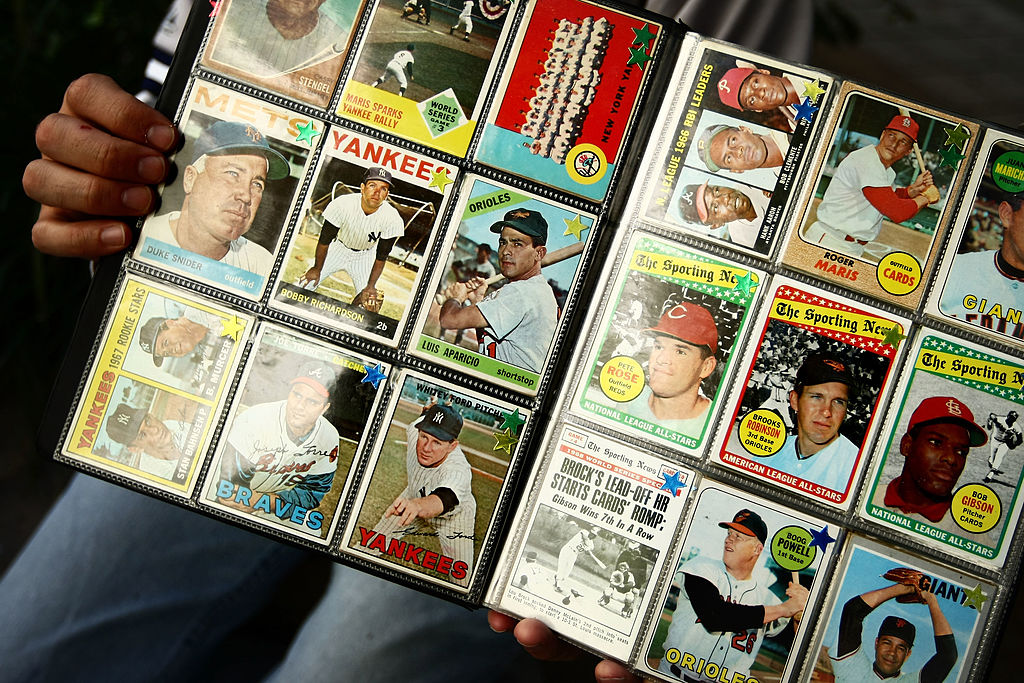
The sports card industry—once the wholesome domain of America’s youth trying to own a piece of their favorite player—has morphed into a high-stakes, multi-billion dollar business that has former collectors and addiction experts raising concerns that it has become a form of legalized gambling.
Gone are the days when kids were racing to their local store in hopes of pulling a cardboard image of their hero from inside a fifty-cent bubble card pack, replaced today by modern collectors spending thousands of dollars, sometimes on a single pack, in pursuit of trying to find rare limited edition cards that can then be resold on the secondary market at a profit.
In a video viewed more than 200,000 times, sports card enthusiast George Wiley discussed his experience in the industry, where he witnessed firsthand the struggle many collectors had with controlling their impulses.
“I was understanding that I was contributing to people who were really deep into addictions, the thrill of collecting, and the greed associated with the big hit, and it was also something that I was struggling with,” said Mr. Wiley, who admitted that his lack of self-control put him $20,000 in debt.
“I had a guy tell me once, ship my cards to my office because I don’t want my wife to know I was breaking,” he added.
The video was followed by comments from thousands of collectors. Many claimed they could relate to Mr. Wiley’s experience, with one man posting: “I’m a recovering drug addict, but about 2 years ago I found a new ‘drug’ in the form of ripping wax and the hardest part is the fact that this drug is so easy to acquire! I haven’t even dared to add up what I’ve spent in the last couple years.”
‘Sports Card Addiction’
In January, a federal agent blew up his career to support what his family called his “sports card addiction.” Homeland Security special agent Sean M. Nelson, 44, of Mesa, Arizona, pleaded guilty to using his government-provided car to earn money to support his sports card purchases, according to the U.S. Attorney’s Office in the District of Arizona.
At the sentencing, a letter was submitted by Mr. Nelson’s mother, who pleaded for probation for the father of four, recalling his childhood interest in cards that would later consume him. “No one knew the hobby of collecting would turn into an addiction,” she wrote.
A judge sentenced Mr. Nelson to two years of federal probation and ordered him to pay $133,999 in restitution.
While there is little research available on sports card addiction, Brook McKenzie, the chief operating officer at Burning Tree Programs, an addiction treatment center, told The Epoch Times that identifying the extent of the problem can usually best be measured by the number of obstacles it creates.
“The difference between a hobby and an addiction often lies in the impact it has on an individual’s life,” said Mr. McKenzie.
“Collecting can become problematic for some individuals. If someone’s collecting habits lead to negative consequences in their life—such as financial strain, neglect of responsibilities, or interpersonal conflicts, and they continue collecting despite these consequences—then it might be characterized as compulsive or addictive behavior.”
In recent years, the sports card industry has experienced a remarkable resurgence in popularity. One of the key reasons has been the introduction of scarcity, with manufacturers strategically limiting the production of certain cards. By the 1990s, card companies began placing serial numbers on cards and placing odds on the backs of packs. As a result, collectors became driven to buy packs to seek out rare cards, which, if found, can then be resold on the secondary market, sometimes for huge profits.
In April 2021, a 2003–04 Upper Deck Exquisite Collection RPA LeBron James card, numbered out of 23, was sold for $5.2 million.
Don Drooker, a consultant at AZ Sports Cards in Phoenix, Arizona, told The Epoch Times that the debate over whether the sports card business has crossed the line into gambling depends largely on the intent of the buyer.
“If you want to consider it gambling, that is a matter of opinion,” said Mr. Drooker. “There are still collectors out there, like myself, who enjoy collecting the cards or are trying to complete a set.
“For the people that are chasing the hit cards, it’s worse than gambling. It is more like the lottery; the odds are really stacked against you.”