



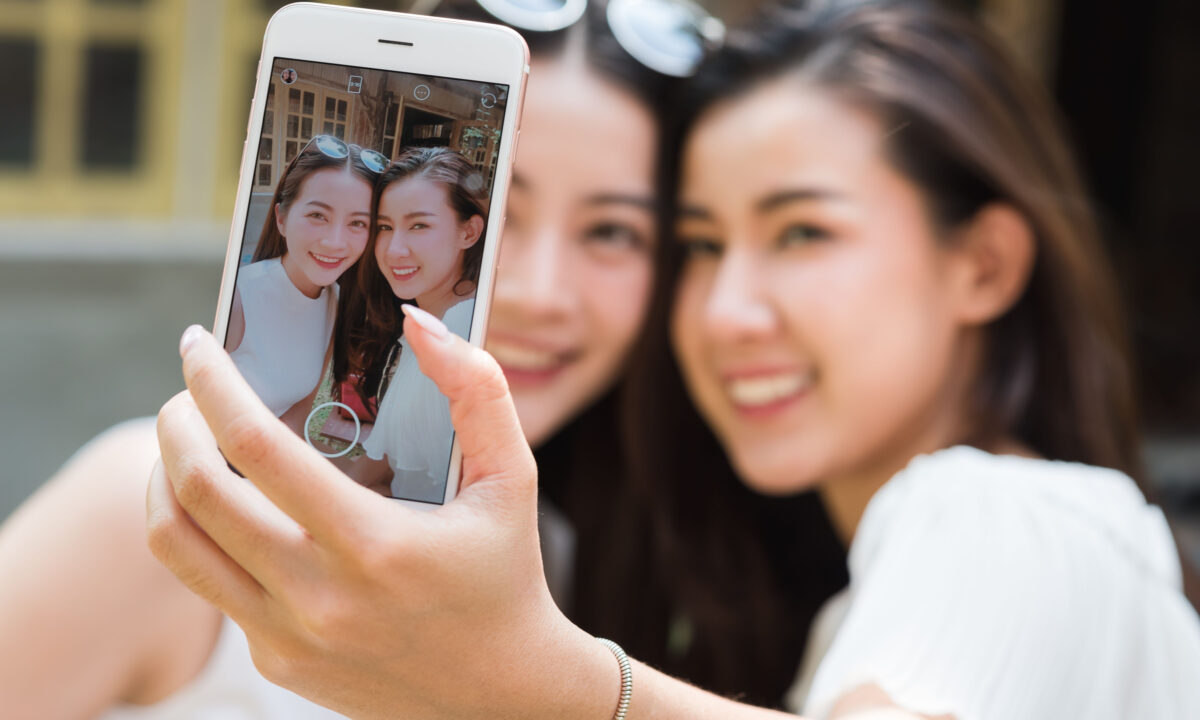
Young female Instagram users tend to focus on body images of their peers more than their faces, concentrating on those with thinner figures and physical features that don’t mirror their own anatomical areas of dissatisfaction.
That’s the main finding of a study entitled “Thinstagram,” published in August 2022 in the journal Computers in Human Behavior.
The study tracked the eye movements of 60 female participants and also had them complete an attitudinal survey.
Engaging in Social Comparison
Specifically, the women rated a selection of images taken from the social media platform on a scale of under-to-over-weight. Researchers used those displays to make the arrays used in the final study, each of which contained 12 images (two each of under-weight and average-weight bodies and faces). The group of women who took part in the final study viewed these images while their eye movements were recorded, and then completed the body-satisfaction measure.
Summarized, the analysis found that participants selectively attended to bodies versus faces, and underweight and average body shapes versus overweight ones. They also avoided looking at images that reflected their own areas of lower body discontent.
“The most significant finding is the fact that both bottom-up (a feature of the stimulus) and top-down (the participant’s own beliefs/views) can influence gaze behavior in the context of viewing body images on social media,” Graham G. Scott of the University of the West of Scotland told The Epoch Times. Scott conducted the study.
“Hopefully future research can build on this and come up with some proposed guidelines for social media companies, particularly around filters, and algorithms that may expose vulnerable users to damaging content,” he added.
“What they’re showing is that people tend to engage in social comparison with people that are thinner and more desirable than them, making them feel ultimately worse,” said Dr. Thea Gallagher, a nationally-recognized psychologist, anxiety specialist and co-host of the “Mind in View” podcast.
Gallagher works with adolescents and people of all ages with anxiety issues and disorders. She said younger females are especially susceptible to receiving content that’s sent to them in algorithms in line with their values and ideas.
“If images of other people in our cohort are similar in shape but somewhat thinner, we tend to be drawn to compare what we think is better and thinner,” added Gallagher, making the point that most often a person isn’t comparing themselves to everyone but only to those who are thinner, which leads to feeling worse about themselves.
‘Landmine’ of Unrealistic Images
Additionally, the images young adults and people are comparing themselves to are often inaccurate.
“There’s a significant number of people filtering photos and therefore making comparisons to something that may not be real to begin with,” said Gallagher. “That’s leading to negative cognitive emotions.”
She described Instagram as a “landmine,” because it’s largely a picture platform full of highly edited photos. Adolescents, Gallagher said, might actually be more vulnerable with their minds drawn to edited images as they try to make sense of looking at something that’s actually not real.
“It’s data and data tells us something,” said Gallagher. “A lot of us can intuit as we age but when you’re younger you want to fit in and there’s such an emphasis on weight and shape.”
Practice Social Boundaries
While Gallagher noted the challenges when it comes to parents monitoring the use of social media by their children—or users monitoring their own use—she did recommend actions adults can suggest and adolescent users can take to protect themselves from increased social comparison.
They include curating their Instagram feed to not just be filled with influencers and those trying to sell products and to be intentional with social media time. She also suggested emphasizing that users look around to see the range of bodies around them and the “real” shapes of people.
“It’s about being aware our brains are going to do this so be careful to watch out for this comparison,” said Gallagher. “But it’s also about deconstructing the cultural mindset of what an acceptable body shape is.”
Gallagher also suggested that adults model healthy relationships with food and emphasize to young people the virtues of being mindful when present with real friends and having fun in the moment.
“If you’re engaging in social comparisons, you’re gonna feel worse,” said Gallagher. “It’s not so much shutting down social media but about practicing social boundaries … It’s about modeling that and having these open discussions about that.”
The study purports to be the first of its kind to show such effects and noted that future research is needed to understand such effects in clinical and/or non-female users of Instagram and other platforms.
Conducted by Scott and Eva Jardine of the school of education and social sciences, the University of the West of Scotland, Zuzana Pinkosova of the computer and information sciences department at the UK’s University of Strathclyde, and Christopher J. Hand of the University of Glasgow in the UK, they can be found through the ScienceDirect website database.