



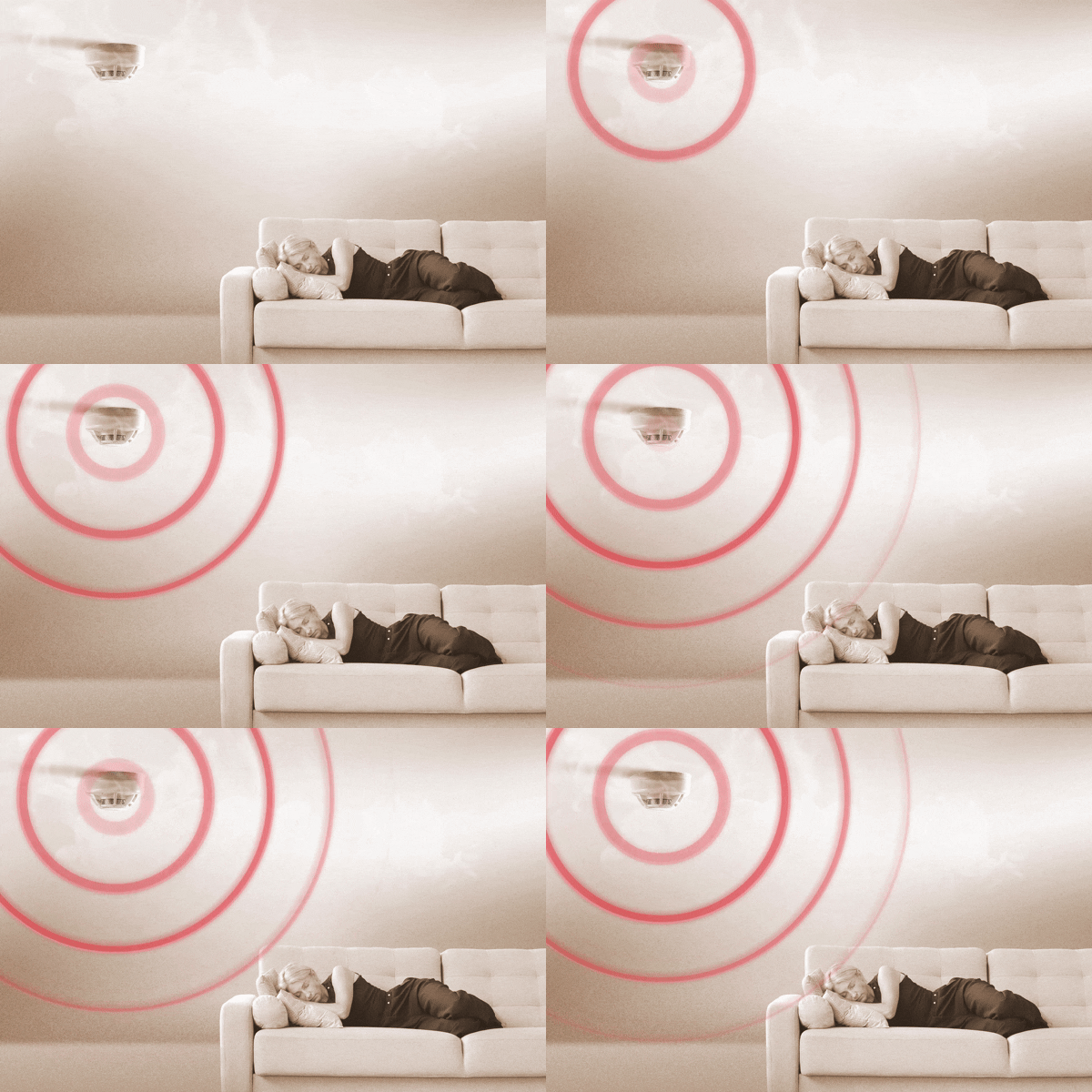
Brenda Hass was roused by the smell of burning after accidentally falling asleep after putting water on her stove to boil. However, if the shrill of her smoke detector had broken the silence, she wouldn’t have been able to hear it.
In 2020, Hass was diagnosed with a progressive form of hearing loss linked to Hashimoto’s disease, an autoimmune thyroid disorder associated with damage to the inner ear’s sound-sensing cells.
“I was terrified to cook after that,” Hass, 55, told The Epoch Times. She can’t hear kitchen timers and now sits on the kitchen floor whenever she uses the stove to keep her eyes alert for potential dangers.
Her experience reflects a broader, overlooked risk. Traditional home smoke detectors emit a high-pitched tone of about 3,100 hertz, roughly equivalent to one of the highest G notes on a piano, a frequency that Hass—and a growing number of adults—can’t hear.
Research has found that lower-frequency alarms work better for people with hearing difficulties, as well as for children and people impaired by alcohol, and wake all sleepers faster than standard smoke alarms. If you or anyone in your home is at risk of sleeping through alarms, you may want to adopt additional safety measures for emergencies.
Low-Frequency Alarms for All
Low-frequency alarms—about an octave above middle C on the piano or 520 Hz—are more effective at alerting the vulnerable.
Research by the National Institute on Deafness and Other Communication Disorders found that among those hard of hearing, 92 percent were awakened by a low-frequency sound, compared with 57 percent awakened by a standard smoke detector. None of the deaf were awakened by the standard signal, although the low-frequency alarm roused 11 percent.
“Low frequency travels through doors and walls better,” Dan Buuck, senior program manager of codes and standards with the National Association of Home Builders, told The Epoch Times. “You’re more likely to feel it, even if you can’t hear it.”
Meanwhile, for those without hearing difficulties, the low-frequency alarm worked 100 percent of the time, compared with the standard alarm’s effectiveness of 92 percent.
A separate study investigated whether smoke alarms designed to wake children are also effective for adults. In the study, 150 hearing adults aged 20 to 49 woke slightly faster from deep sleep with a low-frequency alarm compared with standard, high-frequency alarms. Only one adult didn’t wake to a high-frequency alarm.
“These findings are different than those for children 5–12 years old in our previous studies, where the performance of the high-frequency tone was clearly inferior to that of the other types of alarms,” the authors wrote. “This is important because it is impractical to have separate alarms for children and adults in a household.”
Finding Low-Frequency Alarms
If you live in a newly built apartment building or dormitory or are staying in a new hotel, there’s a chance that smoke will trigger a low-frequency alarm.
Starting in 2021, the national fire alarm and signaling code broadened low-frequency smoke detector requirements for apartment, dorm, and hotel buildings for all residents, not just those with hearing impairments. However, different states and municipalities can have differing fire codes, so it’s best to check.
They’re becoming standard in new multi-unit residential buildings, but face technical challenges in homes.
Powering low-frequency alarms is the biggest obstacle, Buuck said, because they require a speaker similar to those in a home stereo system, which needs more energy than batteries can accommodate. Even the low-frequency alarms that are wired into buildings must have an energy backup, either an alternative energy source or a battery.
“Some states require a 10-year permanent battery, which makes meeting this requirement with a low-frequency alarm even more challenging,” Buuck said.
There are additional technical challenges, he said. Low-frequency alarms must be acoustically tuned, and speakers need magnets to operate—and the magnets that reduce required energy are sourced from a single country.
“There are barriers, but if each of those challenges is worked through one by one, it could be something that does make it to the single–family home market,” Buuck said.
He is aware of only one company offering a low-frequency smoke detector, and it’s a hardwired product that’s part of a smart home package. Before a change is recommended to fire codes, he said, it’s best to have multiple manufacturers offering the product.
Other Alternatives
Apart from low-frequency alarms, the study by the National Institute on Deafness and Other Communication Disorders found that strobe lights—recommended by the National Fire Protection Association and the Americans with Disabilities Act—were effective for 34 percent of those who were hard of hearing and 57 percent of those who were deaf.
Most effective in the study across all populations were tactile bed shakers—designed to tie into smoke detectors, weather radios, or alarms—emitting a low-frequency vibration through a puck placed under a pillow or mattress. Bed shakers woke 93 percent of the deaf, 82 percent of the hard of hearing, and 92 percent of the hearing subjects.
Hass found out about bed shakers after her stovetop fire. Her local fire department told her to contact the American Red Cross for a free bed shaker smoke detector, and the agency installed it several weeks later.
However, bed shakers can be cost-prohibitive and cannot be mandated in building codes, according to Kelly Ransdell, director of public education at the National Fire Protection Association. It can also be difficult to get the word out about alternative tools.
How to Prepare for Emergencies
Working smoke alarms can reduce the likelihood of dying in a home fire by more than half, according to Val Ziavras, senior technical services engineer at the National Fire Protection Association, who noted that more U.S. house fire deaths happen in homes with no alarms or nonworking alarms.
Homeowners should not only test and maintain their smoke detectors but also test whether they’ll hear alerts and establish a home escape plan. You can use the smoke detector test button to determine whether you can hear the alarm, or test the higher frequencies using this online chart. If you live with others, you can test the alarms while they sleep.
“Home escape planning goes hand-in-hand with smoke alarms,” Ziavras told The Epoch Times in an email, noting that your local fire department can also offer more guidance if needed.
If someone in your home is deaf, hard of hearing, or needs assistance getting up and out, assign someone to help wake them in the event of an emergency, Ransdell said.
Ask for Help
There could be other emergencies you may need to be aware of, too. Hass has experienced two other problematic disaster alerts since her hearing loss, each prompting her to adopt a different assistive technology that she was previously unaware existed.
During wildfires in her community, she discovered evacuation orders would come through police sirens that she couldn’t hear. She called emergency services and learned that she needed to enroll in the local special needs alerts and identification program, available in most communities, to alert local first responders about special needs in advance of emergencies. They were able to call Hass’s phone and notify her of evacuations.
During a tornado warning, Hass said she heard the siren, but said it sounded more like a vacuum on a low setting. After that, she downloaded the Federal Emergency Management Agency’s app on her phone, which vibrates during weather alerts in her area.
Taking hearing loss seriously can also help avoid disasters, she said.
Research suggests that a quarter of Americans aged 12 and older have some form of hearing loss. Those aged 65 and older are 2 1/2 times more likely to die in a fire, in part because they don’t hear alarms and also because of medications and other factors that make it more difficult to quickly evacuate.
When Hass’s hearing was deteriorating, her son asked if she could hear the water running in the sink. She couldn’t, and realized that her house could easily flood. Thus, she began taking hearing screening tests regularly and eventually got hearing aids.
“Even though hearing loss is a horrible thing—and hearing aids can only help a little bit—I will always continue to strive to live my life to the absolute fullest way possible,” she said. “But I must be much more vigilant of my surroundings.”