



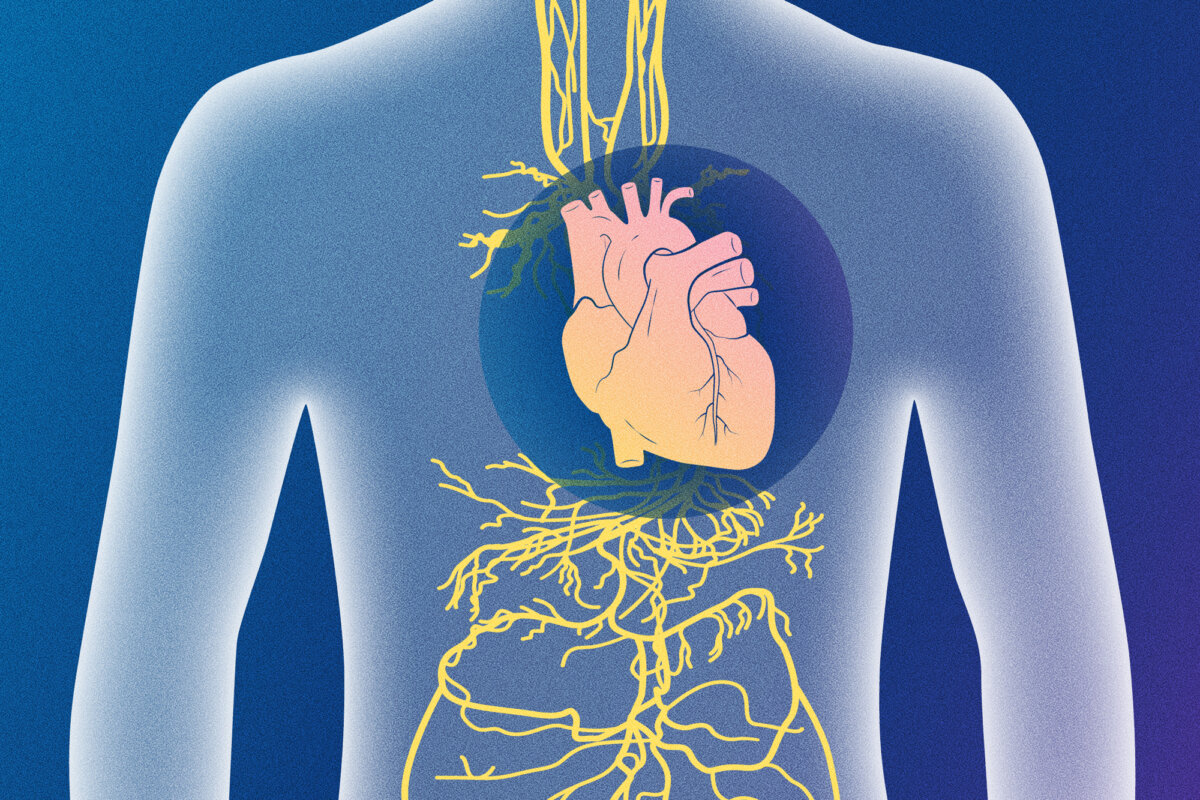
Making better food choices and staying active aren’t the only ways to care for your heart. Activating the vagus nerve might be the missing link in your treatment plan.
By improving the vagus nerve function, “we support the heart’s natural resilience and give ourselves a powerful tool against the inflammatory and stress-driven triggers of cardiovascular disease,” Nasha Winters, a naturopathic doctor, told The Epoch Times.
The vagus nerve directly affects heart health, including heart rate, blood pressure, and inflammation: the pillars of a healthy heart. Stimulating the vagus nerve is not just a strategy for stress management but is also at the core of heart health and recovery.
Practices such as cultivating heart coherence and maintaining adequate magnesium levels may offer simple, effective ways to improve heart function and stress resilience.
Between the Heart and Brain
The heart and brain communicate bi-directionally. The vagus nerve plays a vital role in communication between the two organs, helping control heart function.
The heart sends feedback to the brain about its current state, such as heart rate and pressure, through neural and biochemical signals. This feedback helps the brain make decisions about stress response, emotions, and overall regulation. In turn, the brain influences the heart’s function by adjusting the heart rate and blood pressure through the vagus nerve and other pathways.
Since the vagus nerve affects the heart, vagus nerve stimulation (VNS) is being explored as a possible treatment for heart problems such as cardiac arrest (when the heart stops beating), heart attack, and stroke.
Heart Rate Variability
Heart rate variability (HRV) is a noninvasive way to measure the state of the nervous system and is an essential tool in assessing vagus nerve activity and cardiac health. It measures the intervals between heartbeats, indicating how well the body can transition between calm and stressful states.
“HRV has become increasingly valuable in guiding clinical decision-making and offering patients real-time feedback on their cardiovascular and overall autonomic health,” Winters said.
Autonomic health refers to how well the autonomic nervous system—which includes heart rate, digestion, and stress response—functions. The vagus nerve, a key part of the parasympathetic branch of the autonomic nervous system, helps regulate these functions.
In clinical practice, monitoring HRV can help identify patients at risk of various heart-related issues, such as hypertension, arrhythmias, and even heart attacks, according to Winters.
A high HRV generally indicates a healthy, adaptable heart with a good vagal tone (or vagus nerve function), reflecting the heart’s ability to respond flexibly to stressors and quickly return to a relaxed state. This adaptability is a sign of resilience and strong cardiovascular function.
On the other hand, a low HRV is often associated with poor vagal tone and increased cardiovascular risk, as it signals a diminished capacity to handle stress and recover effectively, Winters said.
Anyone can monitor their HRV at home using wearable devices or mobile apps to give insight into how sleep, exercise, and nutrition affect their stress responses. This feedback also helps people identify triggers of stress or cardiovascular strain, allowing them to make adjustments.
When HRV drops, device-based VNS is one option to improve it. However, natural, more accessible alternatives to stimulate the vagus nerve for better heart function exist.
Get Enough Magnesium
Magnesium plays an important role in both vagus nerve function and cardiovascular health and has a calming, stabilizing effect that supports healthy nerve function and helps regulate heart rhythm, blood pressure, and muscle relaxation.
Also, when we experience stress, the body depletes magnesium, which can lower vagal tone, Winters said.
“Sufficient magnesium intake keeps the vagus nerve ‘primed’ to effectively manage stress responses, maintaining balance in the nervous system and acting as a natural relaxant for all muscles, including the heart muscle,” she said.
Magnesium is found in a variety of foods, including nuts, seeds, whole grains, and leafy greens such as spinach and kale. The following are a few magnesium-rich snacks or meals:
- Spinach and avocado salad topped with sunflower seeds
- Quinoa bowl with roasted almonds and kale
- Oatmeal made with almond milk, chia seeds, and a handful of walnuts
- Greek yogurt with pumpkin seeds
- Chickpea, spinach, and avocado salad with a drizzle of olive oil
- Handful of almonds or cashews
- Kale, hummus, and sesame seeds wrap
Improve Heart Coherence
Heart coherence is a physiological state in which the body’s systems, including the heart, brain, breathing, and hormones, are in sync.
“It is a high-performance and healthy state, physically, emotionally, mentally and spiritually, where the heart’s rhythms are smooth, stable and consistent,” Priyal Modi, an integrative medicine practitioner and breathwork expert, told The Epoch Times.
It also supports emotion regulation, promotes empathy, and strengthens social connections, Modi said.
HeartMath Model
The HeartMath Coherence Model is an approach that uses specific techniques, such as heart-focused breathing, to sync the heart and brain and bring heart rhythm into a more coherent state. It is recognized as a science-based, integrative health care approach that connects to the vagus nerve by influencing HRV, enhancing parasympathetic activity, and reducing stress.
One of the techniques featured in the model is the HeartMath Quick Coherence Technique. It can be done anytime and anywhere, and it takes only a minute. This is how you do it:
- Focus your attention on your heart area and imagine your breath flowing in and out through your chest.
- Maintaining a smooth rhythm, inhale for five seconds, then exhale for five.
- As you breathe, bring to mind a feeling of love or appreciation for someone, something, or a place.
- Continue for a few minutes.
Ultimately, caring for the heart is about more than just monitoring numbers; it’s about nurturing the body’s natural systems of balance and resilience, according to Winters.
“With each deep breath, dietary choice, or mindful pause, we enhance our vagal tone, improve HRV, and ultimately foster a resilient, adaptable heart that is better equipped to face the challenges of modern life,” she said.