



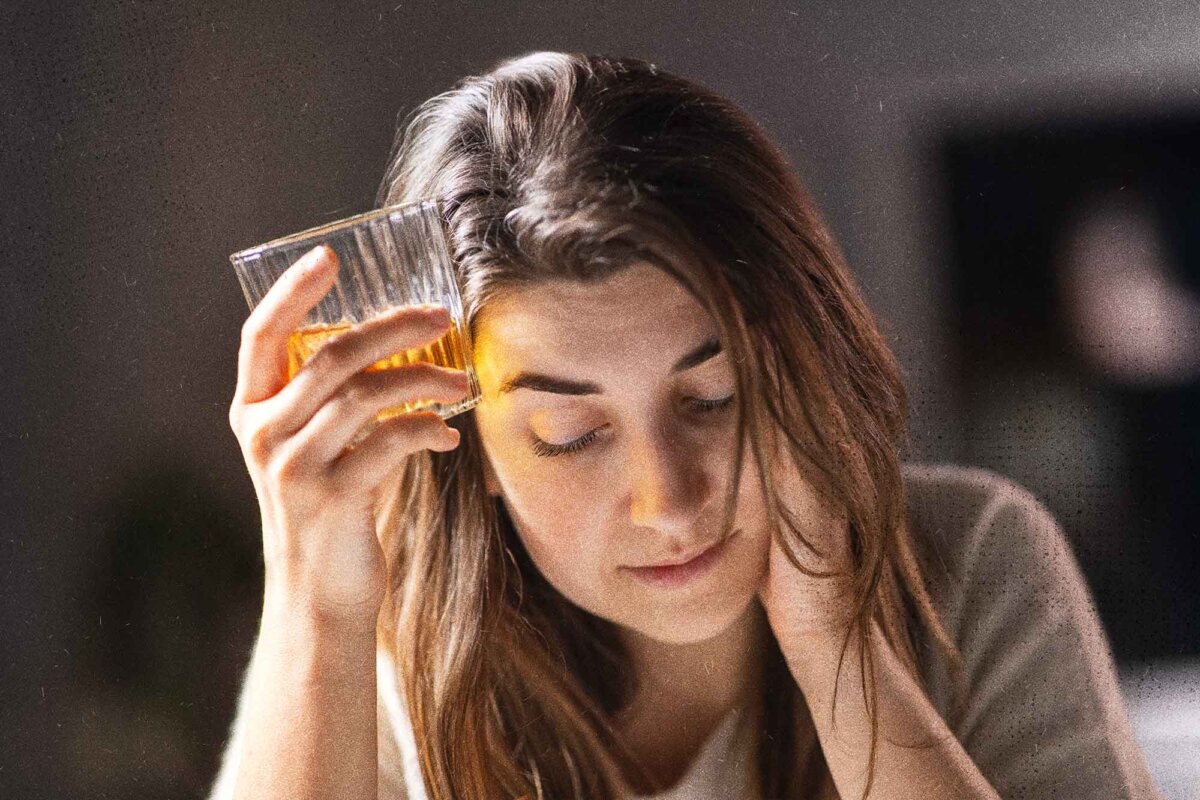
Sharon had been trying different treatment programs for her alcohol use. At age 34, she enrolled in an outpatient program. “Periodically, I get drunk,” she told her therapist. The therapist enlisted the help of Christina Veselak, a licensed psychotherapist and founder and director of the Academy for Addiction and Mental Health Nutrition, who specializes in chronic relapsing.
“You say periodically?” Veselak asked Sharon. “Do you know when?”
She replied, “No, it just kind of happens out of the blue, and I just go out and get drunk.”
For many women, the week before a period is a monthly battle against the body and mind. The tension, the anxiety, and the sheer discomfort are enough to make many women want to crawl out of their skin. A 2015 review of 13 studies found that for 67 percent of participating women, the answer was opening a bottle of wine for a fleeting promise of relief.
Estrogen and alcohol engage in a complex dance, influencing women’s drinking behavior throughout their menstrual cycles. Estrogen fluctuations can affect alcohol cravings, its rewarding effects, binge drinking, and even susceptibility to dependence. Alcohol, in turn, can change estrogen levels, potentially increasing the risk of certain health problems, including breast cancer. This two-way street is understudied despite its implications for women’s health.
“I have found in my 40 years of work that most women, when they relapse [from alcohol sobriety], relapse premenstrually, as both estrogen and progesterone drop towards baseline,” Veselak said. “There are very real biochemical reasons for this.”
According to Veselak, this biochemical vulnerability to increased cravings, binge drinking, and possibly addiction highlights the cyclical nature of a woman’s experience with her hormones and alcohol. The hormonal dance influences how women’s bodies and brains respond to alcohol at different times of the month.
So that feeling of wanting to crawl out of your skin isn’t—yet is—all in your head.
The Hormonal Roller Coaster
A woman’s estrogen levels fluctuate throughout her menstrual cycle, and her inclination to reach for a drink may seem to rise and fall along with it.
Certain phases of a woman’s cycle may be associated with increased alcohol consumption in some women. While this is not a universal experience, and other factors such as social context, stress levels, and individual differences play a role, the link does offer some clues to those seeking to understand their drinking patterns.
Two phases of the menstrual cycle stand out in terms of trends in alcohol consumption.
Ovulation
During ovulation, peaks in estrogen, dopamine, and reward sensitivity can increase impulsivity and risk-taking with alcohol.
A 2024 preclinical study published in Nature shed light on these connections. The researchers found that female mice in the high estrogen phase had higher estrogen levels in their ovaries, blood, and brain than mice in the low estrogen phase.
“Along with the surge in estrogen comes this surge in this binge alcohol drinking,” Kristen E. Pleil, senior author of the study and an associate professor of pharmacology at Weill Cornell Medicine, told The Epoch Times.
Pleil noted that estrogen-driven alcohol use requires no history of drinking.
“From the first time the female sees alcohol, if she’s in a high estrogen state, she drinks more than her equivalents that are seeing the first alcohol,” she said.
Pleil said this pattern of increased drinking during the high estrogen phase can be particularly risky. Not only does it impair decision-making and influence behavior, but also, high levels of alcohol in the system are more toxic. Ultimately, the intense toxicity of drinking is worse in women, she observed.
“If you also drink even more than you normally would, so you have four drinks instead of two, the acute toxicity of that alcohol is going to be even worse,” Pleil said.
Although the study examined mice, Pleil noted that there is correlational evidence from humans that females have a more positive subjective experience of drinking alcohol—and potentially feel more anxiety relief—when they are in the high estrogen stage of the menstrual cycle.
Notably, human research on alcohol use has mostly focused on men. Much less is understood about what influences drinking behavior in women, and there is a need for human studies.
“We’re getting better … [at] addressing these mechanisms in females and actually studying females,” Pleil said. “But we have centuries of data that’s primarily in males. And we’re constantly learning that many of these things don’t work the same in females or … might be similar, but not the same.”
Luteal Phase
Research supports increased alcohol craving and consumption during the luteal phase for women with alcohol use disorder (AUD). AUD is defined as a problematic pattern of alcohol use leading to clinically significant impairment or distress and can be mild, moderate, or severe. For healthy women, the National Institute on Alcohol Abuse and Alcoholism considers at-risk alcohol use as more than three drinks per occasion or seven drinks per week.
The luteal phase is dominated by progesterone, which, in some women with AUD, may increase cravings and the use of alcohol to cope with premenstrual symptoms. During the late luteal phase, both estrogen and progesterone drop, which can further heighten cravings.
The drop in hormones and subsequent increase in cravings is reflected in research on alcohol use during the luteal phase. A study published in Psychology of Addictive Behaviors found that women in treatment for alcohol use disorder drank more during the latter part of their cycle (mid-luteal phase, late luteal phase, and menses) and that both preexisting depression and emotional distress during the cycle influenced the strength of their cravings.
Existing research on women without AUD is mixed. Some studies suggest that women without AUD drink more during the late luteal phase (premenstrual) or during menstruation, while others find no such link.
A study conducted with female college students explored the complex relationship between hormones, mood, and alcohol use. Researchers found that a drop in progesterone made women more likely to drink, particularly if they were in a negative mood that day. Interestingly, a rise in progesterone made them more likely to drink if they were in a positive mood.
It’s important to note that progesterone levels drop significantly in the late luteal phase (roughly five days before menstruation) and during menstruation. Progesterone levels are typically highest about six to eight days after ovulation. While the study focused on progesterone’s influence, fluctuations in progesterone occur within the context of changing estrogen levels throughout the cycle.
The question remains: Why do some women experience changes in their alcohol consumption tied to hormone fluctuations throughout their menstrual cycle? The answer lies in understanding the delicate dance happening in the brain.
The Brain on Estrogen and Alcohol
“Estrogen throws off everything, and estrogen throws off the brain,” Veselak said.
When estrogen levels decline, serotonin levels can also decrease, she explained. Symptoms of low serotonin include feeling anxious, agitated, or depressed. Women may experience cravings for sugar or alcohol, increased irritability, an inclination toward perfectionism and rigidity, and a tendency to worry so much that they have trouble getting to sleep.
As progesterone drops at the end of the cycle, levels of gamma-aminobutyric acid (GABA), an amino acid that functions as a neurotransmitter, also decrease.
“Signs of low GABA are muscle tension, maybe even muscle cramping, and anxiety—but more of a physical anxiety—more physical tension,” Veselak said.
In other words, it is the feeling of wanting to crawl out of your skin.
“That in itself is going to set off this conditioned craving in the brain for alcohol,” she said.
Veselak explained that low levels of serotonin and GABA can contribute to emotional discomfort and a desire for relief. Women may reach for alcohol to assuage their unease.
“We find a mood-altering chemical or behavior that fires those neurotransmitters that are depleted and brings us relief,” she said. “We like it. We love it. We want more.”
That glass of wine can seem like a simple solution to that feeling of wanting to crawl out of your skin.
“It’s like you have everything working against you in that week,” she said.
Relapse in Recovery
There was a clear pattern of relapse for Sharon. As it turned out, her pattern reflected that the nights she over-drank were the nights before her period started every month. It was a sign that her period was coming. Her cycle was consistently 28 days long. On day 27, she would get drunk.
“We just see it all over and over and over and over again,” Veselak said. “Women relapse premenstrually. Low neurotransmitters lead to cravings in early recovery. Period.”
A 2-Way Street
While estrogen can influence alcohol consumption, drinking can also affect estrogen levels. Alcohol’s effect on estrogen levels can have significant implications for women’s health, particularly concerning breast cancer risk.
Alcohol can change the way a woman’s body metabolizes estrogen, causing blood estrogen levels to rise. The liver, the primary site of estrogen processing, prioritizes alcohol metabolism when it is present. This prioritization can interfere with the normal breakdown and elimination of estrogen, leading to a buildup of the hormone in the bloodstream.
Higher estrogen levels are linked to an increased risk of breast cancer. Even moderate alcohol consumption, defined as one drink or less per day, can increase estrogen levels in women. This means that even those who don’t consider themselves “heavy drinkers” may still be at increased risk because of alcohol’s hormonal effects.
Beyond breast cancer, disrupted estrogen levels can contribute to other health issues, including menstrual irregularities, fertility problems, bone health, and mood changes.
The relationship between alcohol, estrogen, and breast cancer is not fully understood, and ongoing research continues to explore the interactions. However, the existing evidence strongly suggests that by limiting alcohol intake, women can potentially reduce their risk of breast cancer.
Tracking and Nutrition
A simple yet powerful step that women can take to understand how their cycles influence their drinking habits is tracking. Keeping a record of their menstrual cycle, whether in an app or a calendar, allows women to identify periods of increased vulnerability to alcohol cravings.
“Circle [your expected period] in red in your day timer,” Veselak said. “It’s not always the full 10 days before your period, but it can be the full 10 days for some really susceptible women.”
Tracking ovulation can also provide insights into potential binge drinking patterns related to peak estrogen levels.
Veselak emphasized the importance of nutrition, especially protein, in managing cravings and stabilizing mood. She suggested having 20 grams of protein every three hours to stabilize blood sugar and neurotransmitter levels.
“Blood sugar also becomes more dysregulated at the end of the cycle, and this contributes to impulsivity as well,” she said.
She also suggested that supplements such as 5-HTP, an amino acid-derived precursor to serotonin, and GABA can be helpful for managing symptoms and cravings. However, she recommended prioritizing food sources first.
“I begin with food, I end with food, and in the middle, I use purified food,” she said. “Amino acid precursors of our mood-mediating neurotransmitters are purified food.
“I can turn off a craving using either the right amino acid or protein within 20 minutes, and I’ve been doing it for 30 years.”
Connecting the dots between one’s place in the menstrual cycle and one’s approach to alcohol is vital for those looking to cut back on drinking or keep a more even emotional keel. Opting for a protein-rich snack, such as grass-fed beef or pasture-raised eggs, can be a helpful strategy for managing cravings and avoiding the feeling of wanting to crawl out of your skin without resorting to alcohol.
Understanding the connections between your menstrual cycle, fluctuating hormones, and your behavior, including how you use alcohol, can be incredibly informative, Pleil said. It offers a valuable opportunity to reflect on your own drinking habits in relation to your hormonal cycles.
If it’s problematic drinking, she noted, monitoring and understanding these patterns can be a way to curb the negative effects of alcohol.
As research continues to uncover the complex relationship between hormones and alcohol, it’s essential to tune into your own body’s rhythms. In the end, you are the expert on your body. Paying attention to its patterns and how they affect your drinking habits empowers you to make informed choices about your health.
If you or someone you know is experiencing cravings for alcohol, you can find more information and support here.