



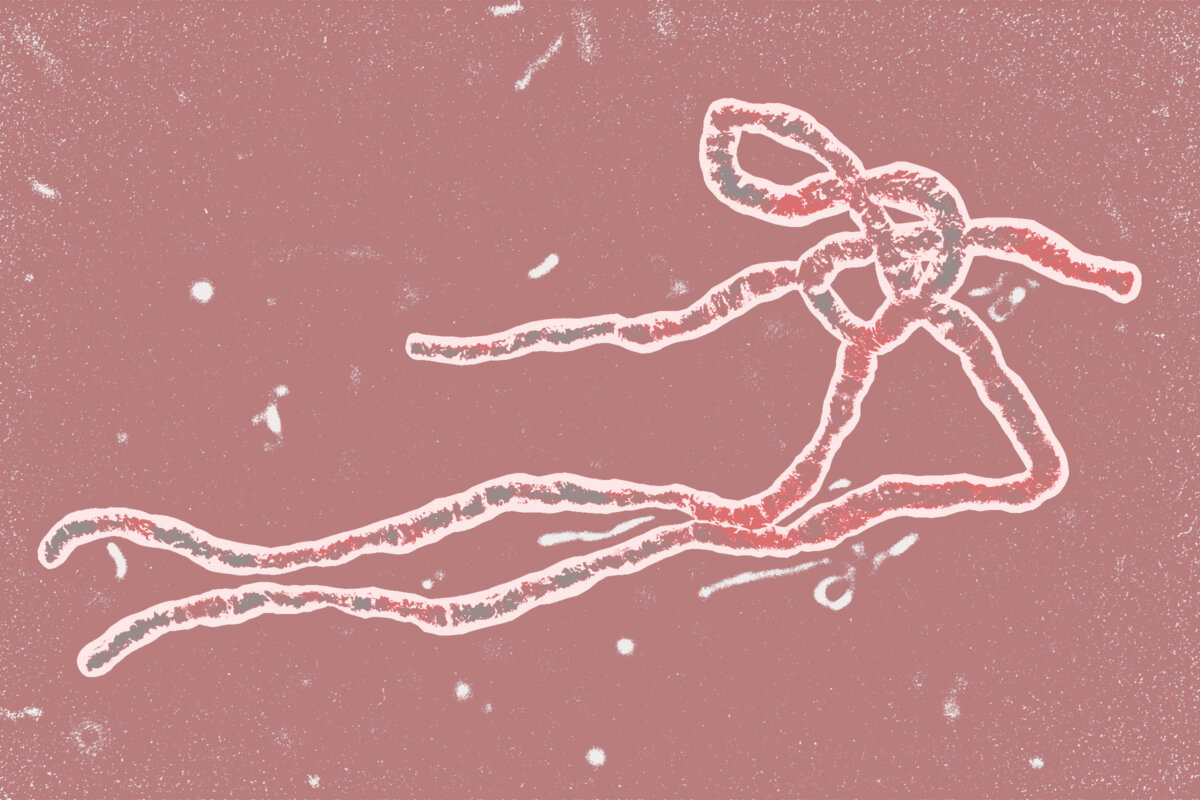
Every few years, a deadly Ebola outbreak emerges and makes headlines around the world.
Despite its high fatality rate, what many people don’t realize is that the virus has remained largely confined to Africa and has never spread widely to other parts of the world.
Low Transmissibility
All of the known Ebola viruses with the potential to cause human disease are found in Africa, Dr. John Schieffelin, section chief of pediatric infectious disease at Tulane University School of Medicine, told The Epoch Times.
“Based on what we know today, they are unlikely to originate outside of Africa in the future,” Schieffelin said, unless bigger and more frequent outbreaks occur.
Ebola virus likely originates from viruses in bats, and scientists have detected genetic material of Ebola viruses in bats specific to Africa.
Unlike COVID-19 and influenza, the virus that causes Ebola doesn’t transmit through aerosols; it transmits through direct human contact and bodily fluids such as vomit, saliva, blood, and contaminated clothing.
Outbreaks have therefore mostly been limited to close contacts and among healthcare professionals rather than among the general population.
The outbreaks often happen in rural places, and locals become infected by eating bush meat, caring for sick people, or certain funeral rituals.
“I’ve been to the area, it’s a very, very poor part of the world,” Dr. John Sinnott, medical director of global health at Tampa General Hospital, told The Epoch Times.
Dr. Georges C. Benjamin, CEO of the American Public Health Association, said, “In the morning, women will often go out and find animals dead on the ground, and they will use them for meat, and that’s called bush meat.”
He told The Epoch Times that there is a very small chance that there will be a big Ebola outbreak in the United States, “but the likelihood is moderate that we’ll have a case.”
Just 1 Case Is Serious
Unlike COVID-19, which can cause moderate or mild conditions or even infect people asymptomatically, Ebola is much more virulent.
Just detecting one case of Ebola is enough to declare an outbreak, Dr. Jennifer Serwanga, an immunologist and assistant director of research at the Uganda Virus Research Institute, told The Epoch Times.
Ebola has a high fatality rate of up to 90 percent, so few people survive to pass on their immunity to the virus. Also, because cases are often in rural locations, new outbreaks can appear in locations where the virus has never appeared before—where group immunity hasn’t formed.
“Ebola is different from measles or flu,” Sinnott said. “It doesn’t live continuously in human populations. Instead, it jumps from animals—repeatedly—into people, spreads through contact during care and grieving, then disappears.”
Once Ebola viruses infect people, they quickly produce masses of viruses inside immune cells, which generate a much bigger immune response, creating a cytokine storm.
“Ebola is very different from any other viral diseases,” Serwanga said. “It destroys all the organs, causing almost all the organs to start bleeding.”
The virus creates gaps between blood vessels, causing bleeding both internally and externally.
It has low transmissibility largely because people rarely come into contact with it, but once one is exposed to it, infection can happen easily.
“Ebola produces so much human fluids. … It’s so voluminous that people will get infected pretty easily,” Benjamin said. “When we saw Ebola in the last big outbreak that the U.S. was involved in, a lot of people got contaminated.”
Those healthcare workers weren’t contaminated while caring for patients; they became infected when they were removing the protective gear, he said.
Although COVID-19 is caused by only a single virus—SARS-CoV-2—there are different viruses that can cause Ebola.
Since the biggest severe outbreak in 2014 to 2016, people have developed vaccines and antivirals against Ebola, but the Ebola virus that is at the center of the current outbreak has no available treatment or vaccines.
The Mysterious Bundibugyo
The current outbreak is caused by a rare species of Ebola virus called Bundibugyo, named after the location of the first outbreak in 2007.
The Bundibugyo virus is about 30 percent genetically different from other Ebola viruses and much is still unknown about it. Although more common Ebola viruses have been detected in rats, Bundibugyo has not been found in animals.
“Uncertainty is the biggest concern,” Schieffelin said. “In terms of clinical presentation, we don’t have much information. This is only the third outbreak of Bundibugyo virus with fewer than 200 cases previously identified.”
The new outbreak was reported late by almost two months, which is similar to previous Bundibugyo outbreaks in 2007 and 2012, which both took more than a month for detection.
When Ebola breaks out in areas where it has not occurred before, there can be a delay of weeks to months, but for areas where it is endemic, it is usually more swiftly detected.
This new outbreak location has historically been an epicenter for other Ebola outbreaks, but the local authorities didn’t test for Bundibugyo when cases started appearing, so missed early cases.
Early symptoms of Ebola can look like a variety of different conditions, Sinnott said, and this also contributes to delay in detection.
“Ebola wears a disguise,” Sinnott said. “Early symptoms—fever, muscle ache, vomiting—look identical to malaria, typhoid, food poisoning, or pregnancy complications. By the time someone recognizes the disease, transmission has often amplified.”
The Unpredictable
Serwanga, whose country of Uganda borders Congo—where the current outbreak originated—said that Ugandan authorities are vigilant.
“[Congo] is a neighbor to Uganda, so we do get concerned, and we do usually have people moving in and out, but there have been some regulations at the border to minimize the crossing of people to and from,” she said.
“We did have two cases that were confirmed, and these were all coming from [Congo], and some measures have been taken, and so far we haven’t seen any new cases.”
The challenge with controlling outbreaks is making sure that there are ample resources supplied, Schieffelin said.
However, with the World Health Organization being stretched with the hantavirus outbreak and the withdrawal of the U.S. Agency for International Development, this has all affected the detection, tracking, and controlling of the new Ebola outbreak.
After concerns surrounding hantavirus a few weeks ago, Ebola is the latest virus to capture attention. There is always a new outbreak appearing.
Benjamin pointed to the simple fact that the world is changing and unpredictable.
“Human beings are in a dynamic world,” he said.