



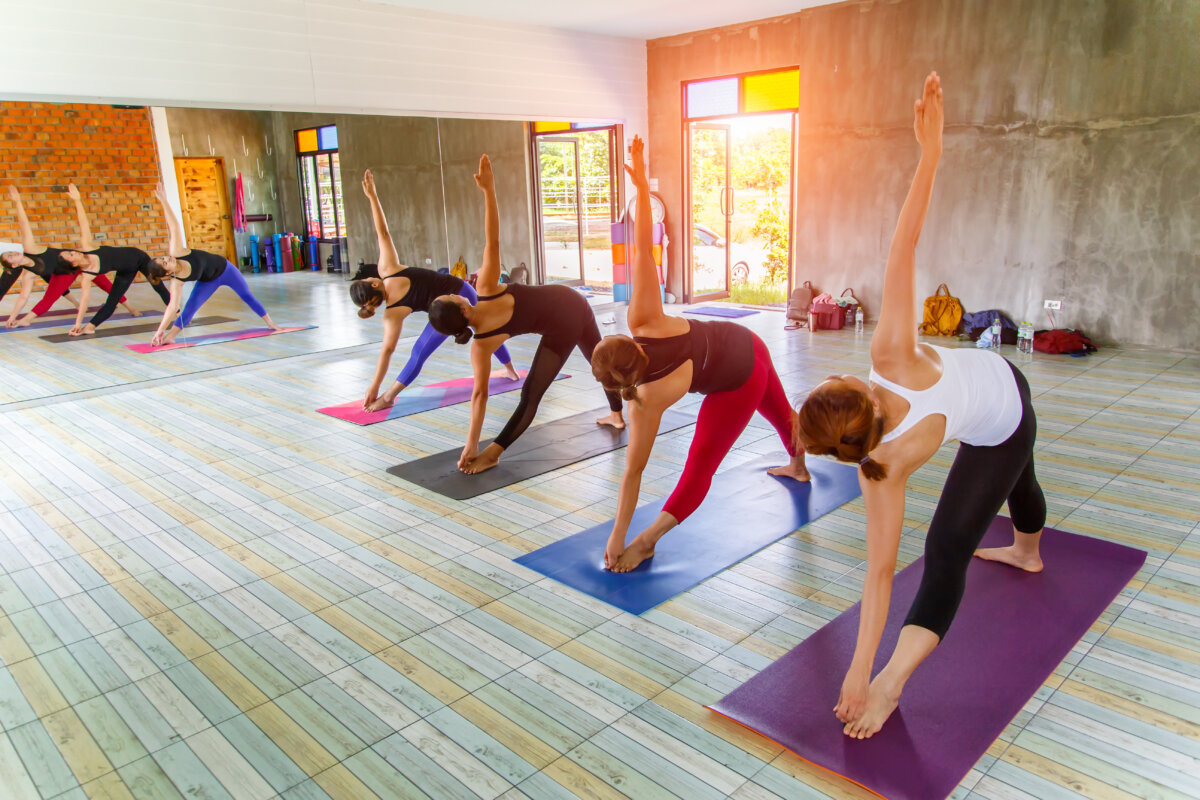
Just one hot yoga session per week can reduce depression, a new study has found, adding to a growing body of research showing that this ancient discipline can lead to improved mood and better mental health.
The most recent randomized controlled clinical trial included adults with moderate to severe depression and found that those who participated in hot yoga sessions felt measurably less depressed after eight weeks.
The study’s 80 participants were randomized into two groups: one that attended 90-minute yoga sessions practiced in a 105 degrees Fahrenheit room, and a second group that was placed on a waitlist. Sixty-five participants were included in the final analysis.
The participants were instructed to attend at least two hot yoga classes per week but averaged just 10.3 classes over the eight weeks.
Even so, the subjects in the yoga-practicing group reported “significantly greater reduction in depressive symptoms” than those in the control group that didn’t participate in yoga, according to the researchers.
The study appeared in October in the Journal of Clinical Psychiatry.
The investigators, from Massachusetts General Hospital and Mass General Brigham, reported that 59.3 percent of the yoga participants showed a 50 percent or greater decrease in symptoms of depression. Forty-four percent of subjects in the yoga group achieved such low scores on the Inventory of Depressive Symptomatology assessment tool that their depression was considered in remission.
The study holds promise for patients hoping to treat their depression using nonmedical interventions.
“Yoga and heat-based interventions could potentially change the course for treatment for patients with depression by providing a non-medication-based approach with additional physical benefits as a bonus,” lead author Maren Nyer said in an article in Harvard University’s Harvard Gazette. Ms. Nyer, who has a doctorate in clinical psychology, is the director of yoga studies at the Depression Clinical & Research Program at Massachusetts General Hospital and an assistant professor of psychiatry at Harvard Medical School.
“We are currently developing new studies with the goal of determining the specific contributions of each element—heat and yoga—to the clinical effects we have observed in depression,” Ms. Nyer told The Harvard Gazette.
Heated Versus Hot Yoga
A heated yoga class and a hot yoga class are slightly different experiences. In a heated yoga class, the room temperature is usually 80 degrees F to 85 degrees F. The boosted temperature feels “cleansing” and comforting, and heat helps to relax muscles, Ohio yoga instructor Kristen Zarzycki told The Epoch Times.
Some practitioners claim that heated yoga can improve circulation, metabolic rate, and flexibility, while increased sweating during a hot yoga class is said to release toxins from the body, although this claim is unproven.
For a true hot yoga class, the room is heated to 95 degrees F to 105 degrees F, as in the Massachusetts study, and the humidity is kept at 40 percent or higher. Bikram yoga, named for its developer, Bikram Choudhury, is a form of hot yoga in which the room is heated to 105 degrees F and participants are guided through a set series of 26 poses, or asanas, over 90 minutes.
More Evidence
In a 2022 study of healthy volunteers with no experience with yoga, those who participated in hot yoga classes for six weeks reported improvements in life satisfaction, general health, mindfulness, and peace of mind and reported a rewarding sense of purpose known as “eudaimonic well-being.” The researchers who conducted this study proposed that yoga benefits practitioners by contributing to increased focus, self-esteem, and energy, and decreased negative emotions.
The physical challenge posed by a hot yoga class combined with a focus on breathing boosts “mindfulness, calmness, determination, and peace of mind,” they wrote.
Adults with major depression also showed significant improvement after twice-weekly standard, unheated yoga classes in a 2017 study.
The researchers who conducted this investigation proposed that the physical exertion, breath regulation, and deep relaxation involved in yoga are all therapeutic elements.
“Each of these yoga elements may comprise an ‘active ingredient’ having its own anti-depressant mechanism(s) of action, triggering mood effects that may be additive or perhaps even synergistic in relation to effects of another active ingredient,” they wrote.
Yoga is an appealing treatment for depression because of its “relatively low cost, ease of access, high social acceptance,” and the perception that yoga treats the “whole person,” according to the researchers.
Other researchers looking into the mechanism behind yoga’s positive effects propose that yoga-based practices correct “underactivity” of the depressed or anxious person’s parasympathetic nervous system and gamma amino-butyric acid system, in part through stimulation of the vagus nerve. In this way, yoga may reduce “allostatic load,” defined as the cumulative burden of chronic stress, they claim.
Is Heating or Breathing the Key?
Ms. Zarzycki, who teaches both hot and standard yoga classes, said she doesn’t doubt the results of studies on heated yoga, but she questioned whether its benefits regarding depression are a result of the heat. She said she believes that the deep breathing encouraged in a yoga class has anti-depressive effects on its own.
“[Yoga] doesn’t have to be hot,” she told The Epoch Times.
“The heat adds the icing on the cake. Though the heat and the sweat are amazing, the breath is everything. You can do nothing more than just lie there and practice breathing and you feel a shift. Breath can change the chemistry in your body. A regular yoga practice can shift the chemistry in your body.”
Evidence does exist that deep breathing alone can at least temporarily relieve stress and anxiety—if not depression. The 4-7-8 breathing technique—which involves inhaling for four seconds, holding the breath for seven seconds, then exhaling for eight seconds—originated in a yoga discipline and has gained popularity as a method to control anxiety.
Any type of deep breathing—whether accompanied by yoga or not—stimulates the vagus nerve, slowing the release of the stress hormone cortisol and lowering blood pressure and heart rate.