
Editor’s Note:
Can you imagine being told by your physician that the best they can do for your chronic pain is 50 percent relief and that you just may have to “learn to live with it”? What hope for healing do the twenty percent of American adults that grapple with daily, chronic pain have? A new study has found that more people suffer from chronic pain than any other condition, including diabetes, hypertension, and depression. These statistics highlight the importance of adequate treatment and prevention methods for non-chronic persistent pain—before it becomes chronic.
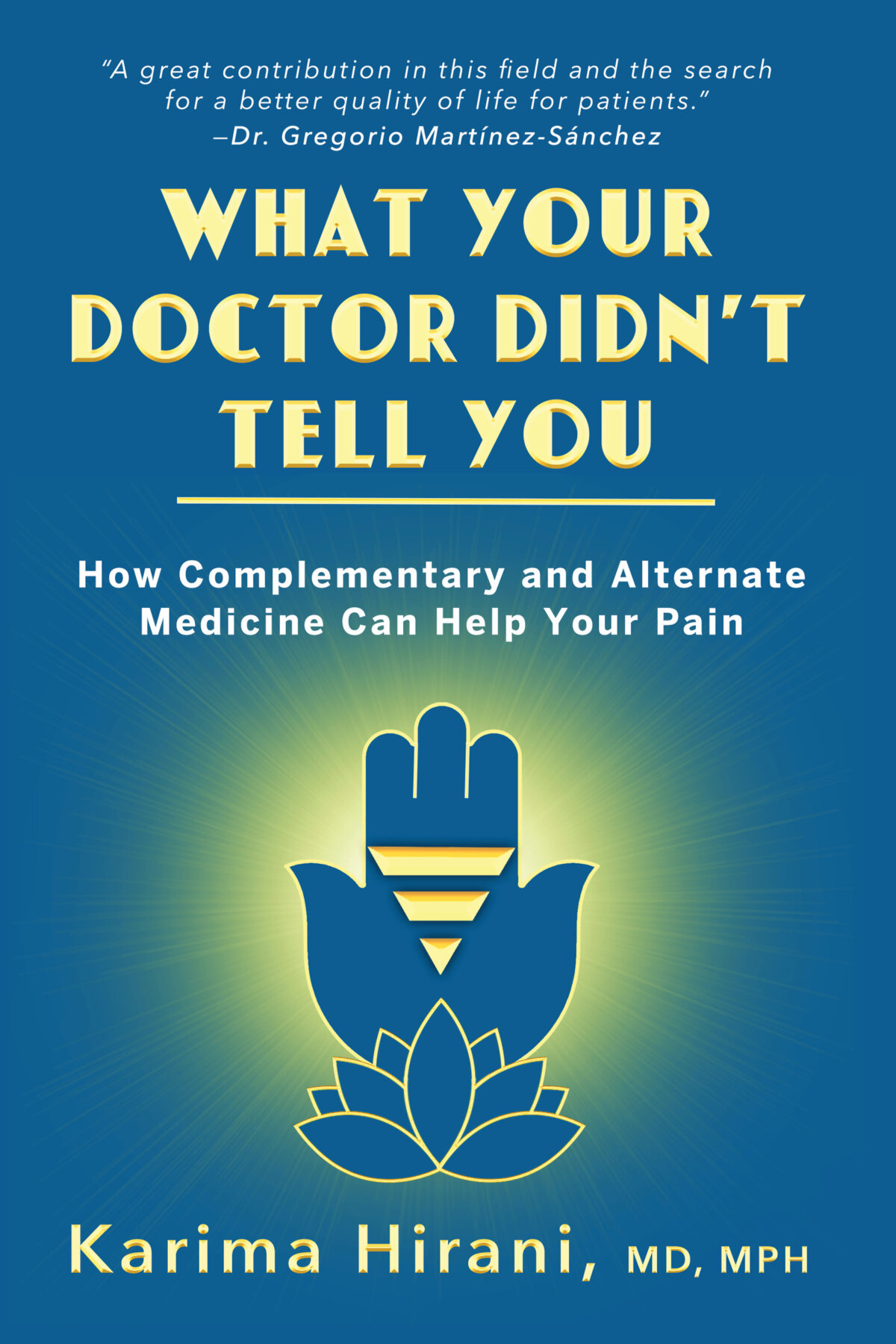
In this excerpt, Dr. Karima Hirani explains the flawed medical treatment methods most often prescribed by doctors—prescription drugs that offer very little hope in long-term pain management—and offers some simple lifestyle changes we can make to boost our health. Further information regarding complementary therapies, including neural trigger point therapy, oxygen-ozone therapy, and others are included in Dr. Hirani’s latest book, “What Your Doctor Didn’t Tell You: How Complementary and Alternative Medicine Can Help Your Pain.”
There Is No Money in Curing Your Pain
You can find relief from your pain, but pursuing traditional routes probably won’t get you there. Why? The reason is simple: There’s no money in it. The unfortunate truth is that the profiteering of others is what controls how you can deal with your pain. I recently attended a pain management conference and was horrified when I heard experts saying things like, “Even with the right combination of pain medications, your patients can only expect 50 percent improvement in their pain.”
Think about it. You are in a pithole of pain; you seek out medical help, but when you go to your doctor, she tells you that the likelihood of success over your pain is only 50 percent. You trust her, so you buy into that. The establishment has told you not to expect much. So, you have no reason not to believe in this message, especially when it’s conveyed by medical professionals. You might end up saying with resignation, “Well, that’s as good as I’m ever going to get.”
You can’t blame these experts entirely for what they think are realistic expectations about pain management. You’ve been told, “Pain medications may help a little, but there are no guarantees.” And all of us have accepted this. As a society, we’ve come to believe what our doctors tell us and settle for less than what we deserve.
This has not been my professional experience. What I’ve seen is that many patients at Hirani Integrative Medicine Center have received relief from their pain.
As a result, I have pursued research over the years to answer the following questions:
- Why do we come to blindly accept what we are told without questioning these highly esteemed institutions?
- Why are we told that we have to learn to live with painful conditions from which we can never fully recover?
A Profit-Driven System
The enemy we all face is a profit-driven system. Name any major problem that exists in our society today, and it almost always has to do with money. Follow the money, and you will usually find the answer to the root cause of these problems. The tragic fact is that there is little profit in getting you back to a pain-free life. It may sound cynical, but many companies profit by you continuing to experience enough pain that keeps you going back to the doctor. What eventually happens is a vicious cycle of pain, pain management, buying more drugs, and becoming reliant on a system and drug industry that doesn’t seem to really want you to get better. It’s that simple—if you got better, then you probably wouldn’t need them anymore.
More than 50 million American adults suffer from chronic pain. [1] The traditional outcomes of pain management are utterly dismal. It’s not just my opinion—this statement is based on statistics, and any expert in pain management will agree. The cost of chronic pain is nearly $600 billion in the United States annually, a sum which includes overall treatment costs as well as loss of productivity. The latter means loss of income resulting from employees who are unable to perform work due to their pain.
I know that statistics aren’t helpful when all you know and care about is that you hurt and are angry that you hurt so much. I’ve had patients who’ve tried everything for their pain, spent thousands of dollars themselves (or, hopefully, through insurance), made countless doctor’s office visits, often suffered years of pain, and are no better than when the pain began. I agree that you should be angry.
But you need to ask yourself a logical question: “If this vicious cycle is so ineffective, why does the status quo of pain management remain unquestioned?” The reality is that it exists due to your continued reliance and blind faith. More importantly, it remains unchallenged based on your willingness to continue to pay for less-than-satisfactory results.
You Are Bribed About Your Pain
We’re taught to trust doctors without question. Somehow, the initials “MD” that traditionally follow doctors’ names makes them seem infallible—if not superheroes. Doctors put on that white coat, and they are suddenly regarded as great founts of wisdom with profound knowledge of everything medical. Doctors are anointed by our society as supreme professionals, and everyone is supposed to hang onto our every word in total belief and trust.
When it comes to treating pain, doctors largely know what is dished out to them by the Establishment—that is, unless they have pursued continuing education in alternative and integrative modalities. Like the medical students and doctors in the previous chapter, you’ve also been bribed when you have low expectations for full recovery from your pain. But you’re not to blame. You are just responding to what you’ve been told by professionals who are put on a pedestal by our society. At a certain point, you will be fed up with hurting without recourse and be moved to seek help based on fresh information that promises hope.
Your doctor didn’t tell you about alternative solutions that are available to you when they said that you may have to live with your pain. Ideally, this pronouncement would have been followed by a combination of prescribed strategies that delivered the “best” results you could have. Chances are that your doctor most likely had nothing much to offer for your pain. When left untreated, pain can have enormous consequences for virtually every aspect of your life—from family and work to play. Anxiety, depression, insomnia, and stress are four of the most common symptoms that accompany chronic pain.
Eliminating Pain Through Diet
The role of diet is vital in my practice, and it is an underlying principle for the successful management of pain. My Master of Public Health degree in nutrition from UCLA is foundational to my role as a physician. When a pain patient of mine who has experienced success comes in for a follow-up visit and reports that he’d been doing well, but then suddenly went downhill, the first question I ask is, “What have you been eating lately?” Almost always with patients like this, the truth comes out that they are making poor food choices.
For some patients, a single dietary infraction can send them spiraling back down into pain for days or weeks. I always try to reassure them that they can come in for pain treatments whenever needed. But I also reinforce their understanding that pain and inflammation are especially responsive to proper diet and nutrition. Poor food choices can cause inflammation, and inflammation can lead to pain.
The Anti-Inflammatory Diet
In particular, what is now called the “gut-brain axis” is talked about extensively in the medical literature. The theory that an anti-inflammatory diet may be beneficial to the gut or the gastrointestinal (GI) microbiome (bacteria in the GI tract) is gaining a lot of traction. This trend supports my initial approach to counseling patients about implementing a pain-preventative diet.
The three most inflammatory foods or food components I ask patients to remove from their diet are gluten, dairy, and sugar. [2] A successful combination I recommend is for them to follow an organic, non-GMO (non-genetically modified organism or pesticide-free foods) regimen, while also avoiding corn and soy. This is supported by a focus on eating a heavily plant-based, [3] low-carbohydrate diet. I emphasize again: if you are suffering from pain and no doctor has yet to suggest a dietary change, you should start by eliminating gluten, dairy, and sugar. Gluten is a protein found in the following grains: wheat, spelt, rye, kamut, and oats (unless specified as gluten-free).
The Mediterranean diet is another approach to eating which has been recognized for having positive effects including on rheumatoid arthritis. Patients who followed the Mediterranean diet showed a moderate or better clinical improvement in their symptoms versus those who didn’t. Also, its beneficial effects on rheumatoid arthritis have been shown in the healthier fats of dieters and as indicated by both the dietary assessment and through the measurement of the blood. [4]
I recognize that changing diets is one of the most difficult things a person can do, so you should know that it doesn’t have to be immediate. You can begin gradually. Following this simple plan should bring you some preliminary pain relief.
You Need to Exercise!
Robert Bonakdar, MD, from the Scripps Center for Integrative Medicine stated at the 2018 Pain Care-Primary Care Conference that diet and exercise can bring about a 25 to 30 percent improvement in pain. [5] If you are unable to be physically active, ask your doctor to make out a prescription for physical therapy (PT). Such specialists can design a customized program to get you moving. Taking this step can be life-changing—especially when combined with diet.
The standard recommendations for physical activities are stretching, strengthening of the muscles, and cardiovascular or aerobic exercise. The contrast in the benefits of frequent movement versus inactivity is quite significant when looking at the causes of chronic pain and illness. [6] Physical and mental well-being can improve dramatically with exercise in pain patients. Hatha Yoga and Tai Chi are two very gentle exercise styles you can try (especially the latter). Classes in both are offered online and in person. So, ask your doctor to assist you in your goal to become physically active.
Pulsed Electromagnetic Field (PEMF) Therapy
Pulsed electromagnetic field therapy, or PEMF therapy, was first developed in Europe in the twentieth century. Since then, it has inspired more than ten thousand publications in the medical literature. More recently, expanded research has been performed in the United States. In the 1980s, the FDA approved the first PEMF device for use in the stimulation of bone growth in non-union fractures. By the 1990s, much of Europe had already become familiar with PEMF therapy. Clearly, the safety and efficacy of PEMF therapy has now been established.
PEMF treatments are generally short, cost-efficient, and, according to some studies on osteoarthritis, have eliminated the need for surgery in many cases, and male pelvic pain syndromes such as prostatitis showed PEMF therapy as a useful, effective modality.
Other conditions that benefit from PEMF therapy include fibromyalgia, diabetic polyneuropathy, LBP, and osteoarthritis. The results are often seen quickly. In one study of patients with disc herniation, anxiety, and depression, their pain and quality of life improved with PEMF therapy. Very early on in this book, I talked about how anxiety, depression, insomnia, and poor quality of life accompany chronic pain. PEMF therapy has the potential to help with all of these symptoms. A paper published in 2007 talked about the benefits of PEMF therapy for migraine headaches. (PDF) [7] Sadly, most doctors are not yet aware of this.
PEMF therapy also appears to be beneficial for more than just pain. I’ve observed it to be useful for the following conditions: improvement of immune function, speedier healing of skin wounds, reduction of inflammation and swelling, improvement of sleep, enhancement of bone health (osteoporosis), and regeneration of nerve tissue.
How Does PEMF Therapy Work?
PEMF therapy uses a device that generates an electrical current to modify the pain signal coming from your brain. The device does this by applying an electromagnetic field to the affected area. When your cells are unhealthy due to disease or inflammation, the electrical voltage of the specific cells is lower. PEMF therapy works to restore your cells to their normal electrical membrane potential. By doing so, PEMF therapy eliminates or significantly reduces pain. [8] PEMF therapy also can heal injury or trauma. [9]
Since your body is made up of mostly water, PEMF therapy will oxygenate, alkalinize, and hydrate your cells, with the result that the transfer of nutrients across your cell membranes will be improved. Ultimately, it can enhance energy production and resolve your pain. Bryant A. Meyers explains in his book PEMF how the Earth’s magnetic fields are just as essential for life and survival as food, water, sunlight, and oxygen. The Earth’s PEMFs protect us from the harmful radiation of the sun. In a certain sense, the cause of disease can be explained as a disconnection of our own bodies from the earth’s PEMFs.
Many of us spend most of our day indoors and away from direct sunlight, the earth’s PEMFs, and fresh air. We also can be guilty of failing to eat healthful, whole foods and not hydrating adequately. Earth-based PEMF machines that operate at frequencies similar to the frequency of the human body are the machines that have been studied the most for pain. The hypothesis behind their effectiveness is that the low frequency produced by PEMF machines resonates with that of our own cells. The procedure can help restore the proper functioning of our cells, which alleviates the pain. Treatment duration can be several minutes up to thirty minutes, twice daily for many days or weeks before realizing benefits.
If you read nothing further in this book, you can do just one thing for yourself if you are a chronic pain sufferer, and it’s quite simple: try to spend at least one hour a day outdoors, barefoot if possible, so that you can benefit from Mother Nature’s natural PEMFs.
Dr. Karima Hirani is a board certified doctor in family medicine. She graduated from USC Medical School and has a masters degree in nutrition from UCLA School of Public Health. She has practiced integrative and complementary/alternative medicine for twenty years, and for over a decade, has used alternative modalities for treating pain.
This excerpt has been adapted from “What Your Doctor Didn’t Tell You: How Complementary and Alternative Medicine Can Help Your Pain,” by Karima Hirani. To buy this book, click here.